
Subscribe to read full article
This section is for paid subscribers only. Our subscription is only $37/- for one full year.
You get unlimited access to all paid section and features on the website with this subscription.
Not ready for a full subscription?
You can access this article for $2, and have it saved to your account for one year.
OUR music-room is our temple. Here for a decade we have worshipped the Goddess of Music. Here we have spent endless hours creating music, but we have worked as humble devotees of our art which demands a lifetime of study, loyalty and love.
The four walls of our music-room have witnessed the making of history, a history so closely and vitally linked with that of film-making. The changing patterns the passing years bring, the musicians and singers who visit us or work with us, the melodies that catch the popular fancy for a while and are forgotten or make a more permanent mark, the learned discussions and discourses that have taken place here—all these are a part of that history.
No work can be more exciting, instructive or exacting than ours. We have been our own teachers and we have imposed on ourselves the most rigid discipline where our work is concerned.
We remember the time a young man walked into our music-room and told us he could sing exactly like K. L. Saigal. We could scarcely believe our ears when, to justify his claim, he sang a song almost as though Saigal himself was singing it. As C. H. Atma sang, his fingers flying over the keys of the harmonium, we knew we had a fine new singer in our midst. The very first film in which he sang for us, "Nagina," became a hit and celebrated its ''silver jubilee."
Almost ten years later, another young man came to our music-room. He was from Calcutta. He, too, sang and we asked him, "Why don't you sing in films?"
He did—in "Kath Putli." The song was "Manzil wohi hai pyaar ki, rahi badal gaye", and the singer, Subir Sen. His first song was an instant success.
Singing in films is a dedication. Only those can sing well who have, apart from a good voice, a zest for life, a passion for the joy which comes from the world of films and film music.
There are singers who, when they face the "mike" for the recording of a song, close their eyes and imagine they are singing before an audience of millions. In contrast to them are gifted singers, like Lata Mangeshkar, who sing primarily for themselves. They sing for their own satisfaction, for the pleasure they derive from it, and leave the rest to the listener. They do not sing for money, but usually collect the largest fortunes.
Mukesh is a colourful personality. The moment he enters our music-room it is an end to all serious work for at least a couple of hours. He takes charge of the conversation and regales us with his jokes and his good-humoured observations on men and women who are in the news in the world of films. We call him "The Prince of Piplinagar" on account of his aristocratic habits and princely bearing. He is Jaikishen's chief rival in creating an impression on visitors to the music-room.
One day we told Mukesh he would make a handsome screen hero. He surprised us by saying that is exactly what he was more than ten years ago—the hero of a film opposite Nalini Jaywant!
Lata Mangeshkar, on the other hand, is a serious-minded singer. There are times when she is in a mood to chat over a cup of tea, but usually she is concerned only about rehearsals. She is so frequent a visitor that if for any reason she stays away for some time we miss her. She is so accustomed to our method of work that it takes her only a few minutes to grasp a tune.
Innumerable songs and melodies are stored in her memory, and she recalls them with ease. Sometimes when we find it difficult to recollect a melody we had composed she furnishes it immediately.
Talaat Mahmood, who sang for us the hit songs of "Daag," is of a quiet disposition, courteous and modest. His quiet nature is in sharp contrast to the boisterous and flamboyant personality of Mukesh.
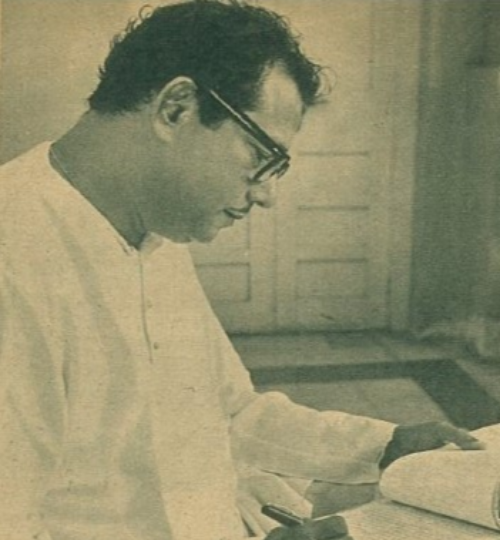
Two lovers of music have frequented this music-room. One of them, Amiya Chakrabarty, is no more with us. The other, Raj Kapoor, even though he is the most welcome visitor, does not find the time to come to our music-room as often as he used to do in the days of "Awaara''. This music-room owes its very existence to Raj Saheb—as we affectionately call him—the producer, director, actor, dreamer, restless seeker of perfection who plays the tabla, the harmonium and the piano with the skill of a virtuoso.
Amiya Chakrabarty was emotional and warm-hearted. Though a successful producer and director, he was always troubled in mind, but outwardly he was cheerful. For hours he would be with us, discussing the songs for his films. The day would pass into night, yet he would remain-until the song assumed the melody he desired. Then he would be very excited over it.
We composed the music for a number of his pictures: "Badal," "Daag," "Patita," "Seema" and ''Kath Putli." If we took long over a song he would flare up, but we did that because we treated it as something special. However, the mutual affection outlasted the trivial irritations.
One day, soon after his return from Delhi, he spent a whole afternoon with us. He was in form and spoke of a great many things. He kept us laughing all the time. There was no trace of the bitterness we used to notice in him. He spoke of the work we had done together and of the wonderful things we were going to do. We felt he was a different man—something had happened to brighten him up. Little did we know that those were his last moments.

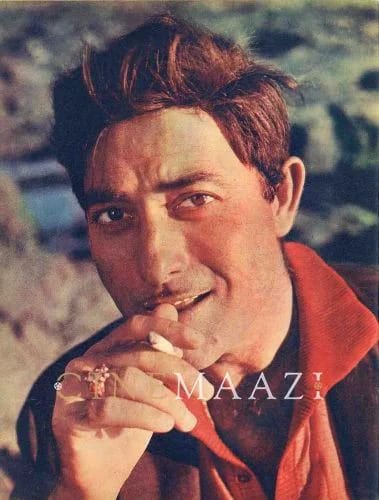
Raj Saheb was with us the other day discussing the songs of his new production. "Jis Desh Men Ganga Behti Hai." We have known him since the days of Prithvi Theatres, and have always been impressed by his boundless energy, good humour and love of music.
On many of his visits to us he plays the harmonium. One day he sang one of our compositions from "Kanhaiya"—"Ruk ja oh janewale ruke ja... "—which had been picturised in Kashmir. Others joined him in the singing and soon Raj Saheb was leading a most bizarre chorus!
Raj often complains we don't use his voice for songs! When he visited the Soviet Union a few years ago he sang "Awaara hun" in the streets of Moscow. The song, sung by him, was recorded by Russian technicians and was incorporated in a film covering the Russian visit of the Indian Film Delegation. Raj often screens this film in the projection-room of his studio. Once he invited us to see it-to prove to us that he can sing!
Among the frequenters of our music-room is Shailendra, the lyricist, who is fond of discussing world politics. He has converted our music-room into a waiting-room for producers. From morning, producers keep coming to corner him, but he is more elusive than the Elusive Pimpernel! Some of them wait patiently for him, and he turns up late in the evening to keep the appointment he has made for the previous morning! We once told him he makes so many people wait for him that our tea bill has gone up twenty times more than what it was.
Because of his progressive views, he has been nicknamed "Torch-bearer". Yet he is one of the most conscientious lyricists in the industry. He is also one of the quickest in composing. Shailendra has written a steady stream of successful songs in the last ten years. His work is significant, refreshingly new, and does not conform to the traditional patterns.
Hasrat Jaipuri, on the other hand, is the very picture of the traditional poet. In his personality as in his work, Hasrat resembles the poets of Urdu literature. Neither politics, nor newspapers, nor the deeds and misdeeds of others, interest him. Absorbed in his work he turns out good songs in spite of bad health.
The other day Kishore Sahu dropped in. As he sat down, Shanker's fingers strayed over the keys of the harmonium, striking a familiar melody. Everybody sat in a silence held together by the spell of the past. It was a song from ''Kali Ghata"—a symbolic link between the past and the future.
The decoration of our music-room has changed from time to time. But among the most precious things there are the two "Filmfare" trophies we won for the music score of "Chori Chori." A trophy we miss is the Grand Prix we received for the music of "Boot Polish" at last year's Asian Film Festival.
Last year Shanker took upon himself the task of renovating the music-room. He had the walls re-painted and ordered new furniture. He also got a set of yellow curtains—the colour Jaikishen hates. Jaikishen resorted to all sorts of excuses to get rid of those curtains! First he said they would give him jaundice. Then both of us persuaded some of our friends to speak for—and against—the curtains. Ultimately, after a good deal of friendly bickering, the yellow curtains were replaced by red ones!
Now our friends, who witnessed the battle of the curtains, are anticipating the battle of the air-conditioner, because one of us is in favour of air-conditioning the music-room and the other is against it!

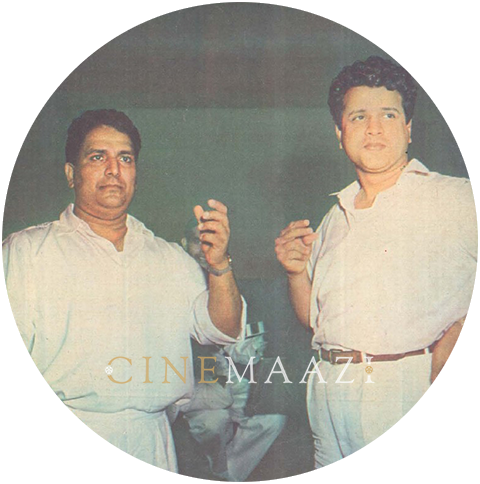
Shanker and Jaiklshen are seen conducting the orchestra.
Rajinder Krishan, the popular lyricist, often expresses surprise at the informality he sees in the music-room. Many fans sneak in at all hours of the day to see how music is composed. They are disappointed. They rarely find both of us together. If in the morning Jaikishen is in the music-room, Shanker stays away. Then Jai goes for lunch and, perhaps, to an afternoon movie, and Shanker drops in for a nap. Sometimes card-games are played and always there are friends.
People ask us when exactly we compose music. We work either early in the morning, when nobody else is about, or late in the evening, after everybody has gone away. Very often we leave the music-room after midnight. At such late sessions only the silent night is witness to the labour which goes into our compositions.
Almost everyone in the music-room is fond of Chinese food and, after a morning recording session, we adjourn for a Chinese lunch. Shanker does not believe in working on an empty stomach! Occasionally both of us go on a strict diet. But little work is done during such periods!
Then there is Dattaram, who is our assistant. Dattu gave an excellent account of himself as music director in "Ab Dilli Dur Nahin" and "Parvarish." He is still seen entertaining his friends in our music-room. One day we laughingly remarked that we shouldn't allow him to come any more, as he, too, was a music director! Next day he fell ill, and we didn't see him for a month. We missed him and were happy when he returned after recovering from illness. In that month we realised how
much he belonged to our music-room.
Every day the postman delivers at our music-room shoals of letters from fans. A fan in Punjab has the legend ''Long Live Shanker-Jaikishen" on his letterhead. These letters make us happy. They also embarrass us, and we are even afraid they may turn our heads. Many college students ask us to attend their functions. Young men and women come every day to see if they can find an "opening" in the world of film music. All these keep us occupied throughout the day. Sometimes we ,desperately desire a rest. At such times, we jump into our cars and drive off to some nearby holiday resort. But even that proves to be a busman's holiday. We work all the time and return with a fresh stock of tunes.
Thus does life go on in our music-room—the changing years, new faces, new ambitions and desires, the ever present music, and the people who love and appreciate it.
When we look back, it seems to us that those who thrilled to the music we composed ten years ago are still enthusiastic about it. It is gratifying to know that our work has perennial appeal to all age groups and classes bf people. It is our hope that ten years hence, too, new melodies will flow from our music-room to make it a citadel of Indian film music.
This article was published in 'Filmfare' magazine's 27 March 1959 edition.
The images and captions are from the orginal article.
About the Author