Subscribe to read full article
This section is for paid subscribers only. Our subscription is only $37/- for one full year.
You get unlimited access to all paid section and features on the website with this subscription.
Not ready for a full subscription?
You can access this article for $2, and have it saved to your account for one year.
The last few years are too close to us to be judged with sufficient detachment and objectivity. At best we can only generalise about a few of the more outstanding trends.
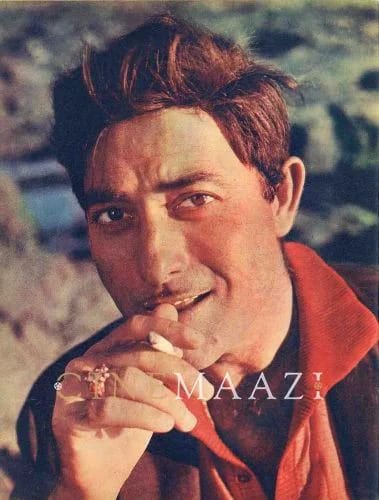
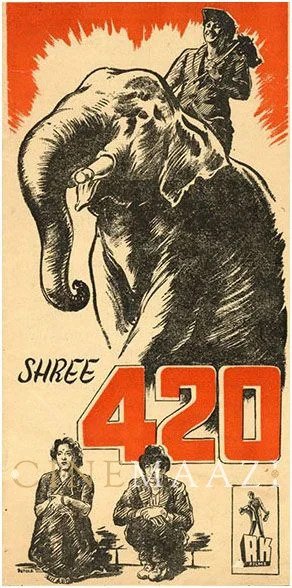
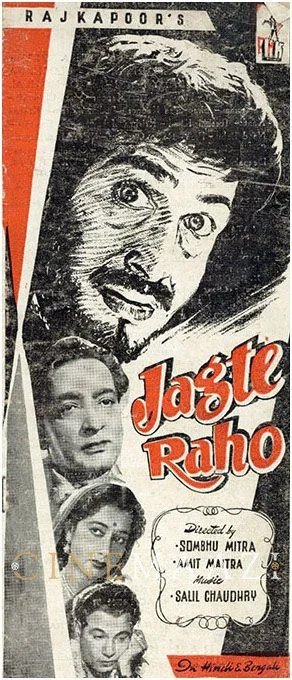
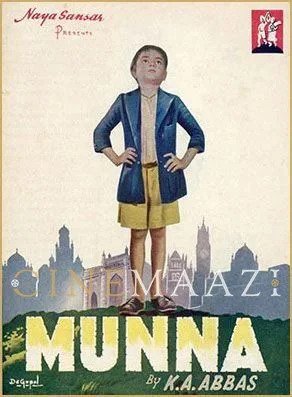
Of the significant films produced in recent years were Raj Kapoor's "Shree 420'' and "Jagte Raho,"K A Abbas' "Rahi" and "Munna" and Bimal Roy's "Do Bigha Zamin" and "Devdas".
"Shree 420" (Nargis, Raj Kapoor, Nadira and Nemo) was the story of a small-town young man who, armed with a university degree and a gold medal (awarded to him at college for honesty), sets out to earn an honest living. No sooner does he set foot in the city than he discovers that honesty pays no dividends. Hunger and privation throw him into the clutches of a big-time crook. In the end, however, he is redeemed through the efforts of a girl who loves him.
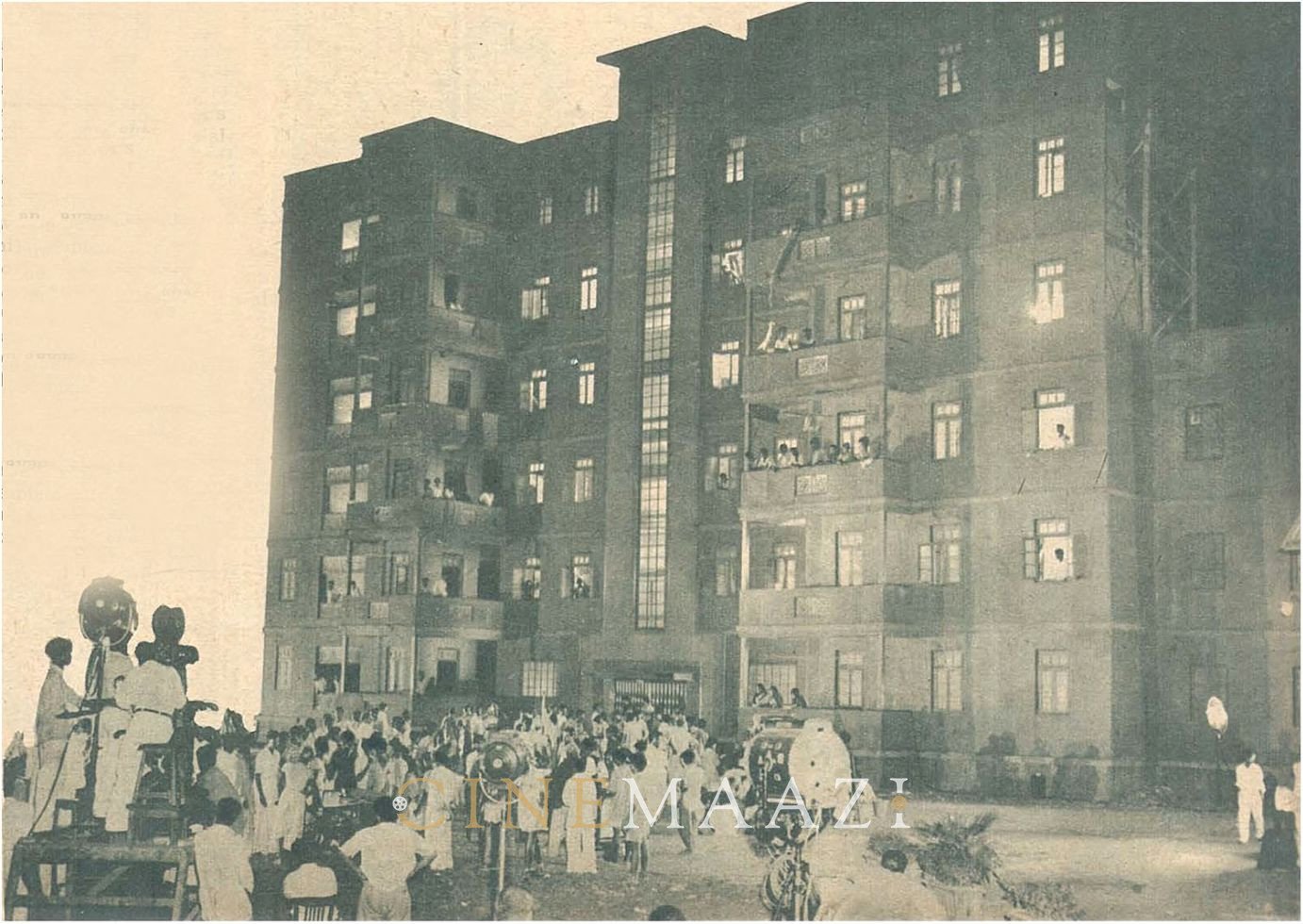
More of his "Little Fellow" stuff was to come in "Jagte Raho" (Raj Kapoor, Pradeep, Sumitra Devi and Smriti Biswas), based on a story by Shambhu Mitra and Amit Moitra, both of whom jointly directed the film. The pace of the story was set with the chase of an innocent man who, through curious circumstances, finds himself branded as a thief. Hunted and pursued, he takes refuge in one flat after another, goes from one room to the next and, in the process, witnesses many antisocial activities and the intrigues peculiar to modern civilisation.
"Rahi" (Nalini Jaywant, Dev Anand, Balraj Sahni and Kate Sethi), adapted from Mulk Raj Anand's novel "Two Leaves And A Bud" and directed by K A Abbas, was released in 1953. The story dealt with workers on a tea plantation, how they are recruited from remote parts of India, come to the plantation dreaming of the land they have been forced to leave and, because they can never earn enough, are condemned to remain where they are, suffering inhuman conditions and treatment. The central character of the film is a petty army officer turned supervisor who falls in love with a tea worker-a girl through whom he recovers his lost faith in life.
The girl's romance with the supervisor, the death of a child through snake bite, the conflict and strike of the workers which dissolve into disarming idealism in the climax are false notes in a setting whose grim reality these incidents do not adequately reflect. But one brilliant touch stands out in the film-the symbolic use of the song "Ek Kali Do Patian," sung by the workers as they gather the tea. The scene, vividly executed and without comment; is a more telling exposition of the theme than the working out of the story with its superimposed romance and plot details.
Abbas' next film "Munna" (Tripti Mitra, Ratan Kumar and David) was the story of a boy who is abandoned by his mother during a famine and is brought up in an orphanage. On the eve of his adoption by a wealthy couple, the boy is rejected when they discover that nothing is known of his origin and caste. The boy escapes from the institution and travels, meeting people of various walks of life during his search for his mother.
"Do Bigha Zamin" (Balraj Sahni, Nirupa Roy and Ratan Kumar), released in 1953, was a high point in the post-war realist trend. With this film Bimal Roy carried forward his earlier exploration of social themes. "Do Bigha Zamin" depicts the struggle of the peasant Shambhu to retain his two bighas of land against the encroachment of the rich zamindar.
Distinguishing this film from earlier ones is the fact that the problem explored is one affecting the majority of India's population. The conflict that Shambhu is caught up in is one that is rooted in the general situation. As Shambhu goes on his bitter rounds of the city, striving to find work and earn the money he needs in order to hold his land, he cannot but fail-one man, alone, and under those conditions.
The forces pitted against him are too enormous. Still he struggles on. We watch and wait for him to collapse under the strain of pounding the streets, dragging like a beast of burden his rickshaw laden with human flesh to earn the few annas which must serve not only to keep body and soul together but must also be stretched to build up the price of his land.
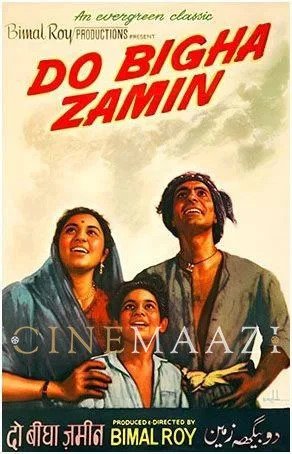
Lonely, bereaved, defeated-solaced only by his little son, Shambhu returns to his village to bring away a handful of the soil which has cost him so dear and is no longer his.
The sincerity of "Do Bigha Zamin" and Balraj Sahni's moving performance in the role of the peasant Shambhu make this an outstanding film. Unfortunately, Bimal Roy does not sustain the high courage of the first half of the film which is interrupted mid-way by irrelevant details in the plot. With this interruption, although Shambhu's plight reengages our sympathy as the picture unfolds, it is never with quite the same force as originally engendered.
The director's lack of confidence in his own ability to pursue the theme to its full realisation is shown in two ways: firstly, by the introduction of the child to the scene to share his father's experiences, an artificial device which does not add to the pathos of Shambhu's situation as intended but makes for a false sentimental appeal to our sympathies, thereby weakening the true poignancy of Shambhu's struggle; and secondly, in the latter half of the picture, when we have come to accept Shambhu in all his dignity and tragedy, the image is destroyed and continuity disturbed as the plot develops with almost the speed of burlesque through the sequences of the goonda's attack on the wife, her flight, accident and death.
Without these extraneous and sometimes banal plot complications "Do Bigha Zamin" might have been a piece of social dynamite and surely a work of full stature in cinema art.
.jpg)
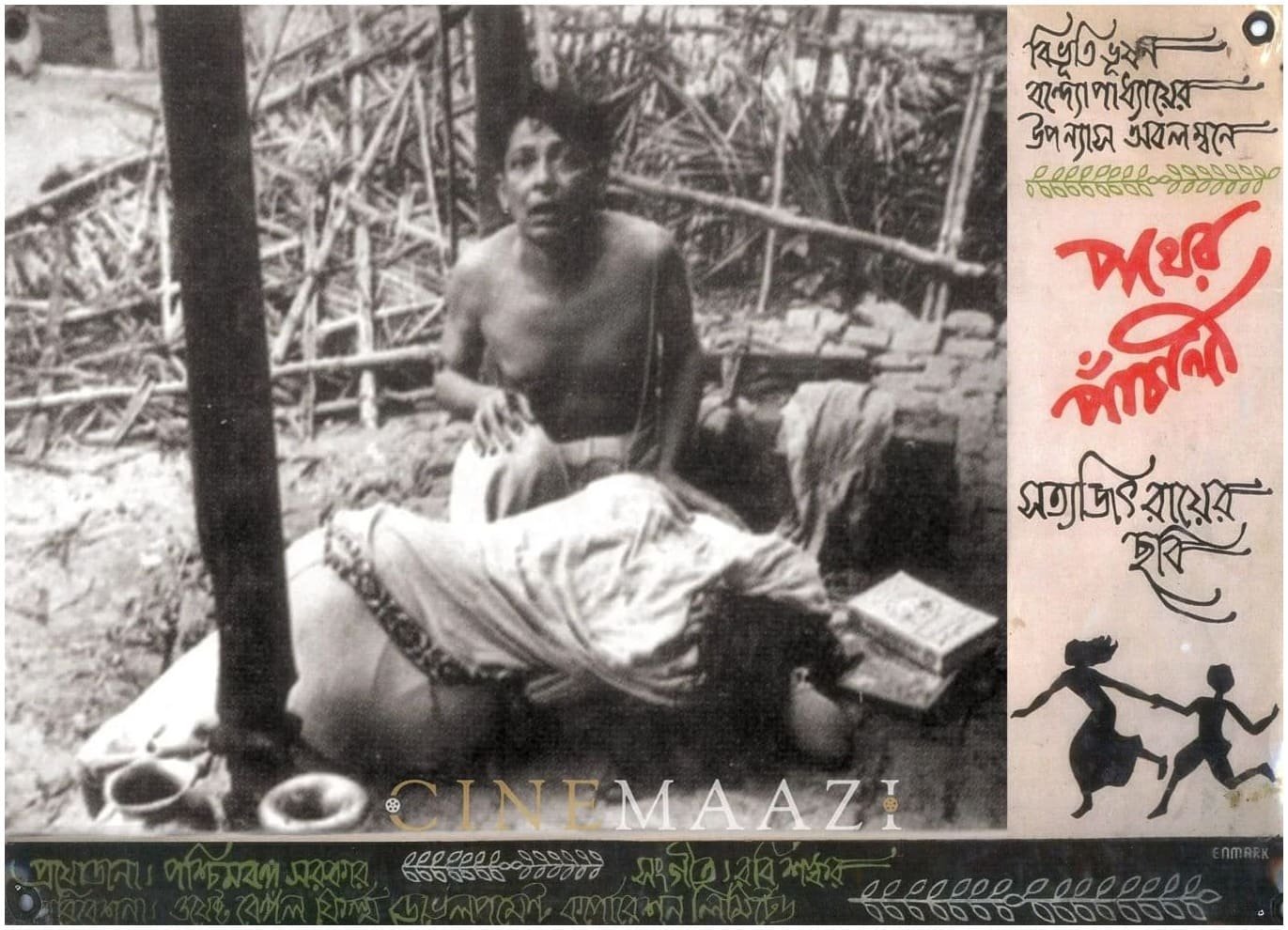
"Aparajito" opens with the family already settled in Banaras. Harihar, the father, earns a Jiving by reciting the Hindu scriptures on a pitch beside the Holy Ganga. His wife looks after the house and little Apu. The son is fascinated by the scampering of monkeys and the urban bustle.
Both these films have had a successful run in Europe and America. Critics the world over have enthusiastically hailed these two masterpieces from India. As a result, Calcutta has become the centre of all avant garde activities. Already a band of bold and daring new directors, Asit Sen, Tapan Sinha and Ritwik Ghatak, have tackled new themes in their films-"Chala Chai," "Kabuliwala," "Louha Kapat" and "Ajantrik."
Matched against this is the moribund cinema of Bombay, with its "sickening twists and turns of the eternal triangle" and its high-powered melodramas. More is the pity that film-makers like Mehboob, Shantaram and Bimal Roy have succumbed to the cash register. Their recent productions, "Mother India,'' "Jhanak Jhanak Payal Baaje" and "Madhumati," have no creative vitality.
About This Series:
This is the concluding instalment in the series "A History of the Indian Film". Rarely has a film journal, here or abroad, published a series of such scope. In the film industry and outside it, this has been the most talked-about .set of articles in the last half-year or so. And that is precisely what we aimed at.
The industry has a light-hearted disdain for facts (if not figures), and to it history is only as good as last month's releases. Under such circumstances, the task of a historian becomes truly uphill. No historian can lay claim to hundred per cent authenticity, yet Mr Garga, with remarkable precision, has managed to sift grain from chaff, and fact from fiction. That his articles have evoked country-wide interest only goes to show the need for a more exhaustive study of the subject. In this regard we draw the attention of the Film Federation of India, the Indian Motion Picture Producers' Association and the Ministry of Information and Broadcasting for necessary sponsorship.
This article was published in 'Filmfare' magazine's 27 March 1959 edition.
About the Author