A Chance, A Neighbour, and A Film - The story behind Shakti Samanta’s Debut | Cinema Memory Project
Image and Narrative contributed by Sundeep Pahwa, New Delhi
Subscribe to read full article
This section is for paid subscribers only. Our subscription is only $37/- for one full year. You get unlimited access to all paid section and features on the website with this subscription.
Histories of Indian cinema have traditionally been constructed around films, stars, studios, and directors, with emphasis placed on commercial success, aesthetic innovation, and institutional milestones. Within this framework, the early careers of major filmmakers are often narrated retrospectively, shaped by later achievements and consolidated reputations. In the case of Shakti Samanta (1926–2009), one of the most influential director-producers in Hindi cinema, scholarly and popular accounts typically begin with his major successes of the late 1950s and 1960s, while the circumstances surrounding his entry into feature film direction receive comparatively limited attention.
This article seeks to address that gap by foregrounding oral testimony as a form of methodology in piecing together a biographical account. It is structured primarily around an interview conducted with Sundeep Pahwa, whose father, Basant Pahwa, played an instrumental role in enabling Shakti Samanta to direct his first feature-length film, Bahu (1955). Rather than treating this testimony as anecdotal or supplementary, the article, as part of our Cinema Memory Project, positions it as a central evidentiary strand through which the early phase of Shakti Samanta’s career can be more precisely understood.
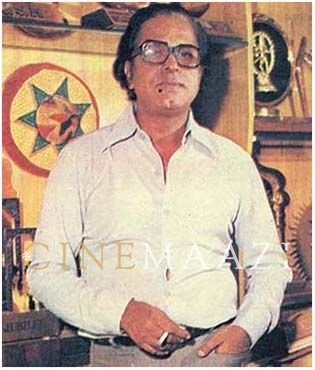
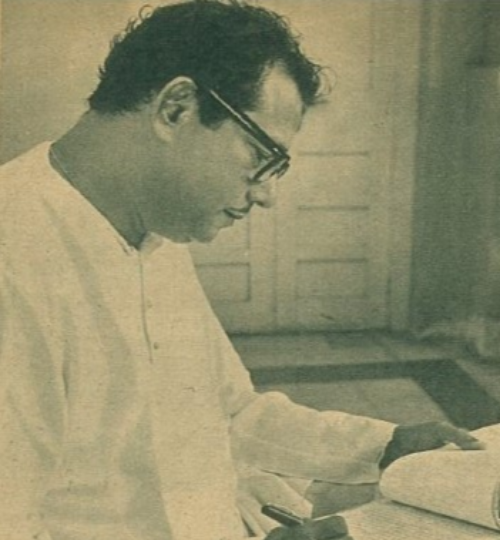
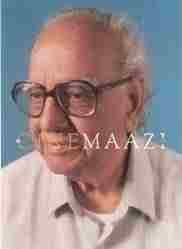
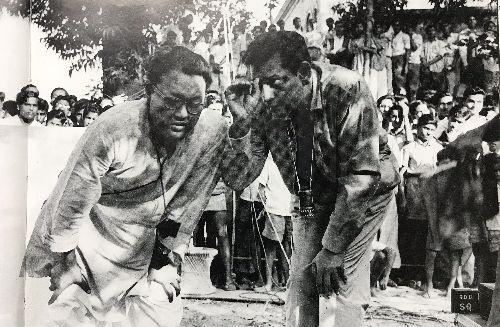
Shakti Samanta
The following narrative that follows is based on an interview conducted with Sundeep Pahwa and is presented as oral history, with contextual biographical information included only where necessary.
The Pahwa Family Before and After Partition
As per Sundeep Pahwa testimony, the Pahwa family was originally based in Lahore, in the undivided Punjab. His grandfather, Sundar Das Pahwa, was educated in London in the early 1900s and worked as a reputed executive engineer in Punjab irrigation department. The family-owned extensive land and property across undivided Punjab and lived in relative financial security before 1947. Sundar Das Pahwa had seven children—six sons and one daughter.
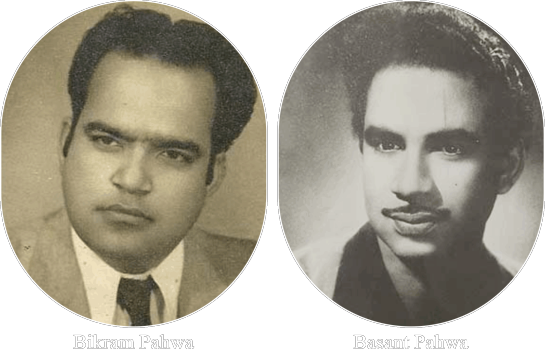
Cinema entered the family through two of the sons – Basant Pahwa and Bikram Pahwa. Basant Pahwa, Sundeep Pahwa’s father, the youngest of all the siblings developed an interest in Hindi films from a very young age and was particularly drawn to the films of Raj Kapoor.
At the time of the Partition of India, the family was vacationing at their summer house in Srinagar. Sundeep Pahwa recalls that a close family relative—the brother of Sundar Das Pahwa, Dr Mathura Das Pahwa—served as the personal physician to Maharaja Hari Singh of Kashmir. Through this connection, the family was flown to Delhi, where they later settled. Sundar Das Pahwa had an untimely demise post appendicitis surgery and left behind an astronomical sum of around 6-7 lakhs rupees for his children.
Partition brought a different kind of struggle to even the most affluent families. After getting displaced from their homeland, different members from the Pahwa family made different choices about rebuilding their lives through the money inherited by them. One of the brothers purchased a plot in Golf Links, Delhi for 15000 rupees, as per Sundeep Pahwa. Dr Mathura Das Pahwa was very close to the family and specifically to him as per Sundeep Pahwa, and he helped them during the struggling time in the 60s when the family had returned to Delhi. Basant Pahwa, however, expressed a different ambition. As recalled by Sundeep Pahwa, Basant Pahwa stated that he wanted to go to Bombay and make a living in films.
Bombay, PR Films, and Neighbourhood Networks
Basant Pahwa married in 1951 and subsequently moved to Bombay. By this time, his brother Bikram Pahwa and him had started a taxi business company. Later, Bikram entered the film industry and established a production company called PR Films.
Basant Pahwa used to live in Trivedi House, 14th Rd, Khar, Bombay. Sundeep Pahwa recalls that Shakti Samanta and sarod maestro Ustad Ali Akbar Khan were also residents of the same building. It was through this shared residential space that Basant Pahwa became acquainted with Shakti Samanta.
At this point in his life, Shakti Samanta was still struggling to establish himself in the film industry. Though he had worked as an assistant director at Bombay Talkies as a Hindi translator for Phani Majumdar’s Bengali scripts and had industry exposure, he had not yet directed a feature-length film. Sundeep Pahwa says that it was Basant Pahwa’s familiarity with him as a neighbour that led him to believe he could direct a film.
Bahu (1955): How the Decision Was Made
Around 1954, PR Films was preparing to produce a feature-length film titled Bahu. Initially, Vrajendra Gaur was expected to direct the film. However, due to prior contractual commitments on a film called Kasturi, he was unable to take on the project. It was at this point that Basant Pahwa suggested Shakti Samanta’s name to his brother Bikram Pahwa. As recounted by Sundeep Pahwa, this suggestion directly resulted in Shakti Samanta being appointed as the director of Bahu marking Shakti Samanta’s first feature-length film as director.
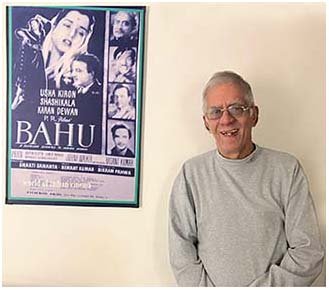
Sundeep Pahwa with a poster of "Bahu" (1955)
The film starred Karan Dewan, Usha Kiran, Shashikala, Pran, and Johnny Walker. Basant Pahwa also acted in the film and played a character with grey shades. Bahu was released at Liberty Cinema in Bombay and later shifted to Krishna Talkies, which was later renovated and reopened as Dreamland in 1970.
At the time of Bahu’s release,V Shantaram’s Jhanak Jhanak Payal Baje (1955) was running successfully at Metro Cinema, which affected the commercial prospects of other films including Bahu in the city. Sundeep Pahwa recalls that a Filmfare review of Bahu was critical of Shakti Samanta’s direction. This review caused significant anger on the part of Bikram Pahwa, who, according to Sundeep Pahwa, tore the review and terminated Shakti Samanta’s contract with PR Films.
Krishna Talkies, later called Dreamland
This episode ended Shakti Samanta’s professional association with PR Films shortly after his first directorial outing. PR Films went on to make only 3 films before shutting down. Their last film was Bombay Race Course released in 1966. However, after Bahu, Shakti Samanta went on to direct Inspector, produced by Nadiadwala, which was released in 1956. As per Sundeep Pahwa, Shakti Samanta demanded a piece of land from Nadiadwala in exchange for his service in the film. Nadiadwala, being a reputed builder in Bombay at that point of time, offered him land at Santa Cruz, Bombay. Shakti Samanta’s family lives in the same house at Santa Cruz even today.
Post Inspector, his career followed a more documented trajectory, including the establishment of Shakti Films and the direction of numerous commercially and critically successful films. Shakti Samanta would eventually direct 37 Hindi films and 6 Bengali films, serve as Chairman of the Central Board of Film Certification, and remain active in cinema until the early 2000s.
Booklet cover of "Inspector" (1956) from Cinemaazi archive
Role of Oral Testimony
While narrating all of these incidents Sundeep Pahwa shared how he was also influenced by the world of Hindi films and wanted to be part of films. He was an avid reader of the Screen magazine and tried his luck in films but unfortunately, it didn’t come to fruition. Years later, when he met Ashim Samanta, son of Shakti Samanta, he was told by him that he should have gone to meet Shakti for work. But sometimes, luck just doesn’t come in your favour.
As an oral history, Sundeep Pahwa’s testimony highlights how neighbourhood relationships, family networks, and informal trust functioned as key mechanisms within the Hindi film industry in the 1950s. The account demonstrates that Shakti Samanta’s first opportunity as a director did not emerge solely from institutional pathways, but through a personal recommendation made by Basant Pahwa, based on everyday familiarity rather than industry hierarchy. This testimony adds an important layer to the understanding of Shakti Samanta’s early career in terms of informal networks in the industry, oral history and situates Bahu (1955) as the outcome of a specific social and historical moment shaped by partition, migration, and proximity.
This section is for paid subscribers only. Our subscription is only $3700/- for one full year. You get unlimited access to all paid section and features on the website with this subscription.


.jpg)