Britain and the Documentary Film - Marie Seton
12 May, 2026 | Archival Reproductions by Cinemaazi
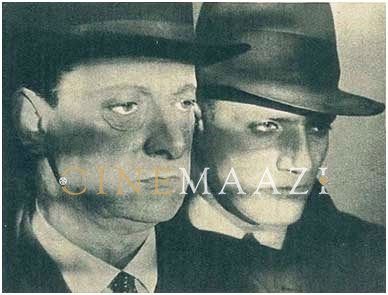
A tense scene from Alfred Hitchcock's "Blackmail," an outstanding British film of the early
years of the talkies
Subscribe to read full article
This section is for paid subscribers only. Our subscription is only $37/- for one full year.
You get unlimited access to all paid section and features on the website with this subscription.
Not ready for a full subscription?
You can access this article for $2, and have it saved to your account for one year.
It is quite possible that I would never have become interested in the cinema but for the accident of where I was born. I was born at Walton-on-Thames, Britain's original "Hollywood." Our house, which was an old one, was an ancient island fast becoming submerged in a tangle of new roads with modern houses. Today, it is suburban; then, it was still "the country."
One day on my way to school, which was on the edge of the next village of Oaklands Park, I passed an open field in which a drama was being acted in front of a motion-picture camera. The scene captivated me. Soon after, gossip spread around about "the film stars who were living" (the suggestion was) "in sin"-in the house of Mr. Cecil Hepworth, the man responsible for making the film. Cecil Hepworth was, in fact, the pioneer producer of British films and he had a house very close to ours.
In this informative article, the author tells of the beginning and development of the documentary film in England
I judge that film-making was held to be disreputable, because my mother and father engaged in a furious row over Cecil Hepworth. My father, who liked to find things out for himself, had ambled round to call' on Hepworth and found him a very pleasant man. My mother was outraged for, while she herself was perfectly ready to consort with stage actors, she drew the line at film actors. But my father won the battle, and the next thing I knew was that he was taking me to meet Britain's first film stars-Alma Taylor, Chrissie White and Henry Edwards. I was about seven years old. The first British film I recall was "Comin' Thro' the Rye" with Alma Taylor, although a much earlier one was "Rescued by Rover," also a Hepworth picture and now labelled the first British story film.
My undoing, so far as films were concerned, was furthered by the enterprise of Mr. Love, the local garage proprietor, who, during the last years of the First World War, converted one of his garages into a hall for showing films. My nurse, against the strict instructions of my mother, smuggled me into the afternoon shows where I saw Theda Bara, the "vamp" of American films, and the passions of Pauline Fredrick in "Madame X."
While the American film gained supremacy during the First World War and in the years following, the British feature film became, for the most part, a sorry imitation of the Hollywood film. British studios specialised in ponderous historical pictures like "Bonnie Prince Charlie," or adapted novels like "Sally Bishop." Here and there some with imagination went to work; for example, Adrian Brunel, who produced all sorts of films, including cartoons, and Percy Smith, a pioneer in nature study films. Smith later joined Mary Field, now of the Children's Film Foundation, during the time she was responsible for "The Secrets of Nature" series produced by Gaumont-British.
Towards the end of the 1920's and the end of the silent era, Alfred Hitchcock, with his talent for thrillers of a distinctive flavour ("I've always been terrified by policemen," he once told me), made a decisive impact with a film called "Blackmail". It was an outstanding British film; moreover, it contributed an imaginative use of sound at a time when "the talkies" were just talkies. Something distinctively British had been projected on to the 'British screen by a British director.
Around the same time another director of imagination appeared- Anthony Asquith (his most memorable film of recent years is "The Young Lover"). Asquith, the son of the onetime Prime Minister, Lord Asquith, and his sensationalist wife, Margot, represented the university youth which became engrossed in films through the advent of the film-society movement which sprang up in universities after 1925. Asquith's first film, "Cottage On Dartmoor," indicated the beneficial influence of the Continental film techniques. It was exceptionally well lighted and photographed.
"Cottage On Dartmoor" and "Blackmail" were the first British feature films which could be regarded as better films. Up to that time British feature films were second-class and, for the most part, produced for purposes of filling the British quota rather than attracting audiences for their own sake. But, while British production as a whole remained drearily nondescript, one type of British picture had a distinctive style. During the war, much film footage had been taken of major naval and military battles. Subsequently, use was made of this material and a series of war films of a documentary nature was produced, among them the battles of Zeebruge, Mons and Ypres. These films demonstrated that the British had a flair for films of actuality and, subsequently, it was in the field of the documentary film or in feature films where the documentary elements were either stressed or simulated, that the British cinema made its special contribution.
It will be recalled from the second article of this series that John Grierson, under the influence of Sergei Eisenstein's "Potemkin," went back to Scotland and made the first British documentary, "Drifters." "Potemkin" and "Drifters" were both presented on the same London Film Society programme on November 10, 1926. The next month Sergei Eisenstein, who was then in Paris, came to London at the invitation of the Film Society to give a series of lectures. He also lectured on his theories of cinematography at Cambridge University.
Eisenstein's lectures were not only attended by John Grierson and Anthony Asquith, but also by numerous other people who, later, made outstanding contributions to the development of the British documentary film and the commencement of documentary movements in Canada and Australia. Eisenstein's "students" included Paul Rotha. Basil Wright, Harry Watt, Edgar Anstey and Thorold Dickinson.
Grierson was the hub of the documentary movement which remained outside of the film industry. His first move was to induce the Empire Marketing Board to sponsor the production of films to promote products like bananas from the West Indies. A few years later, Grierson induced the General Post Office-through the Postmaster General-to allow him to form a film unit, the G.P.O. Film Unit, for spreading knowledge of the mail services. The unit included Wright, Watt and Anstey. It was to this unit that Alberto Cavalcanti, the Brazilian avant-gardist and feature-film director from Paris, came. Cavalcanti worked with the unit both as a producer and on the development of sound experiments. Three of the outstanding films of the mid-thirties were "Song of Ceylon," which was actually financed by a tea company though it contained no advertising; "Nightmail," the story of the Scottish mail train with music by William Walton and words by the poet, W. H. Auden; and "North Sea," dealing with radio communications and weather forecasts.
Meanwhile, Paul Rotha emerged from the role of critic and set up a separate company which sought finance from shipbuilding and airplane companies. Rotha's films were characterised by the beauty of their camerawork. Other documentary directors sought funds from educational institutions for the production of films about children and school conditions. Anstey and Arthur Elton induced the Gas Light and Coke Company to sponsor the remarkable slum reportage film, "Housing Problems." The cost of many of these films was kept at the minimum, because footage taken by one group was used by others; or, as in the case of some of Rotha's films, he shot the footage for a minor film while travelling to and fro in connection with a major film. His film "The Face of Britain" was shot as he passed through the Midlands on his way to Tyneside to shoot "shipyards," When he was making "World of Plenty", the food film; he took over material shot by many others for earlier films.
The whole of the British documentary film movement was motivated by a socially-conscious approach and its members were mainly socialist in outlook and anti-imperialist in sentiment, (Grierson and numerous members, including the present author who wrote for "World Film News," the magazine of the documentary movement, were friendly supporters of V. K. Krishna Menon who simultaneously battled for British workers in the Borough of St. Pancras and for Indian independence through the India League), All the members had a specific cinematic point of view: that of not only projecting conditions of work and life on to the screen, but of depicting people on the job-postmen, railwaymen, radio operators on ships, seamen, coal-miners, in fact, anybody in the most telling and effective cameos, The documentary films of the 1930's and the war years-for instance, Humphrey Jenning's "Letter to Timothy" - have a flavour of intimacy which humanised the industrial scene.
This character came about because of the close and intimate study of the subject. Wherever possible, somebody who had actually been a worker in the industry to be portrayed was incorporated into the unit; or someone who was part of the living scene. Basil Wright's collaborator, and the man who speaks the commentary in "Song of Ceylon," was Lionel Wendt, Ceylon's outstanding musician and photographer.
It is the element of intimacy in British documentaries' of "the Golden Age" (in the post-war years there has been a decline in imagination) which served as a dynamic influence. With the outbreak of the Second World War in 1939, John Grierson, together with Stuart Legg, went to Canada where Grierson founded the National Film Board which now has a special representative–Charlie Marshall-in New Delhi. Harry Watt went to Australia to help in the starting of a documentary movement there.
There is no exaggeration in saying that the influence of the British documentary extended, in the mid-thirties, to the United States, where Per Lorentz was able to obtain Congressional funds during the early years of Roosevelt's New Deal to produce ''The Plow That Broke The Plains" and "The River". These films, in turn, had a stimulating •effect upon the British.
Meanwhile, in the early 'thirties, the British feature film took a leap forward, though admittedly an uncertain leap, with the arrival of the volatile Hungarian cinema virtuoso, Alexander Korda, and his brothers, Vincent, the set designer, and Zoltan, the director. Korda brought imagination to British films; he also drew financial backing from insurance companies and banks for his concern, London Films. Perhaps it is fair to say that Korda served as the spark which also sparked the expansion of the J. Arthur Rank organisation which now dominates the British film industry.
.jpg)
which starred Alec Guinness ill the title role.
Korda turned the tide of British production with "Henry the Eighth," the gayest piece of entertainment that had ever come from a British studio. He set about importing international personalities to invigorate British films. The most successful of them was Rene Clair who came to 'direct the delightful satire, "The Ghost Goes West." Marlene Dietrich, Edward G, Robinson and other Hollywood luminaries came to London Films. H. G, Wells's grandiose "The Shape Of Things To Come" went before the cameras. Production costs soared, but not always by intention as illustrated by the true story of Vincent Korda's costumes for ''The Shape Of Things To Come". Several hundred costumes in cellophane, intended for extras in a sequence depicting the future, were made without the material having been photographically tested. When the scene was developed, the costumes proved invisible!
Tucked away at the studio at Ealing, the more modest Michael Baleon continued to make films, none of which had the show of those produced by London Films. On the eve of the last war, the first film, characteristic of what has since come to be known as "an Ealing film," went into production with a number of Welsh miners taking part, This was the "Proud Valley," starring Paul Robeson, the American Negro actor and singer who had been in England for twelve years. Robeson played the part of a Negro miner and the character was based on a real man, a Negro miner from the West Virginian coalfields, who had found his way into the Welsh pits. Shot on location in Wales, there was a considerable element of the documentary in it, (Paul Robeson had been on friendly terms with the British documentary people for several years), "Proud Valley" was released after the outbreak of war and at a moment when the British were to find their own strength under a hail of bombs and block-busters and, in finding it, they also found a distinctive cinematic language which was translated into numerous feature films.
The sharply-etched cameos of real people in documentary films were expanded into a gallery of national types in a series of feature films: "The Life And Death Of Colonel Blimp"; the memorable yet drab suburban love-story, "Brief Encounter," and, in the post-war years, the amusing "Passport To Pimlico," "The Lavender Hill Mob," "The Man In The White Suit," "Kind Hearts And Coronets" and "The Maggy."
Two interesting directors emerged: Carol Reed, one of the directors of the forceful documentary, "The True Glory," who directed the film classic of "cloak-and-dagger" intrigue, "The Third Man", and David Lean, who evoked the macabre side of Charles Dickens in "Great Expectations". Laurence Olivier, borrowing certain compositions from Eisenstein's "Alexander Nevsky," succeeded in transferring Shakespeare's "Henry V" to the screen, but failed with "Hamlet."
Once again there has appeared a movement outside of the mainstream of the industry. This time it is not called the documentary but experiments in what is called Free Cinema. The central figure in this movement is Lindsay Anderson, the critic. Free Cinema is close to the documentary but it is concerned with the moods and doings of real people, rather than with the man at work. The two outstanding examples are "Tomorrow" with its figures of two deaf-mutes and the enchanting film of teenagers of the East End out on a jazz spree, "Moma Don't Allow". This film has the same freshness as the one current feature of British life which shows a new and genuine struggle of the creative spirit-no matter how modest the skiffle groups, those bands of youth, the general working class, who have taken to going around playing on home-made instruments and strumming out a music derived from folk-music, "Moma Don't Allow" has the quality of what might be called a folk film of London's youth, and as such it may remain a milestone.
This article was published in 'Filmfare' magazine's 20 December 1957 edition.
The images and captions are from the original article.
277 views

.jpg)