

"through the eyes of a child ... '' The Universal Appeal Of Chaplin's Films
Subscribe to read full article
This section is for paid subscribers only. Our subscription is only $37/- for one full year.
You get unlimited access to all paid section and features on the website with this subscription.
Not ready for a full subscription?
You can access this article for $2, and have it saved to your account for one year.
Some months ago there appeared a photograph in a London magazine, which showed Charlie Chaplin on his seventieth birthday surrounded by his young children. He looked placid and contented, contemplating his children.
It seemed incredible that this man of fantastically volatile temperament, whose fate it has been to make more people laugh (and, also, to suddenly come to the brink of tears) than any other man who has ever lived, should have lived to settle down into a family man and reach the age of seventy.
For centuries, the idea of the Clown has stood as a symbol that behind the mask of laughter-making lies tragedy. Chaplin, perhaps the greatest of all Clowns and certainly the most widely-known Clown that has lived, did in fact, in his own life, represent the symbolic idea behind the Clown until his middle age, when life, through a successful marriage, became happier for him.
Very early in life, he was sent for a time to a dreary London orphanage. Later, though enjoying vast international success, his marriages and love affairs all came to a bad end and he seemed dogged, perhaps through his own temperament, by conflict and suffering.
His mother went insane. Still later, he was hounded out of America, his adopted land, under the mistaken notion that so independent a man as he could be only "a communist."
Chaplin's art and life has fascinated writers and more biographies have been written of Chaplin than probably any other living man. Each writer has been captivated by the idea of explaining the universal' appeal of Chaplin's films, and some have gone to extremes of fancy in constructing a theory for their appeal.
Each of his films, including all the early slapstick comedies, are regarded as masterpieces. Irrespective of how old or worn the copies of even the earliest Chaplin films, they still have life in them.
They retain the power to move people—children and adults, and even the world's most intellectual people—by reason of their universality.
Chaplin's special creation of the Tramp for ever in trouble with authority, the Little Man up against the force of big men, has touched the heart of people in every country.
The Japanese produced all sorts of toys in the likeness of Chaplin.
Charles Spencer Chaplin was born in London and into the entertainment world, for his parents were music-hall artists. Thus, Chaplin inherited the immensely old tradition which lies behind vaudeville and can be traced back to the ancient pantomimes and comedy of classical Rome and Greece.
The youthful Chaplin appeared in every form of theatrical production before he was seventeen, when he joined the Karno Pantomime Company. In 1910 he went to America and, for three years before his entrance into films, he toured in a very popular act called "A Night in An English Music Hall". He went to work on his first film at the Mack Sennett Keystone Company in December, 1913.
From that moment up to now, Charlie Chaplin has been evolving one image after another to speak, as it were, for mankind and to mankind.
In writing about Chaplin in "The Film Till Now", Paul Rotha says: "Charles Chaplin's greatest asset is his deep understanding of human nature; an understanding that has not been reached without contact with the low, depressing, morbid side of life; a contact with the underprivileged, the poor and the hungry...
All of Chaplin's films, from the earliest comedies to the last film, "The King in New York," have in essence a single message: the triumph of the Little Man, representing goodness and innocence, over evil.
The film in which this was depicted in the most intense way was "The Great Dictator" (1940), where Chaplin appeared in the dual role of the little Jewish barber who looked identical to Hynkel, the dictator—a character undisguisedly based on Adolph Hitler.
But the most interesting analysis I have ever read of Chaplin's art, and his particular way of looking at life, is that of the great Russian director, Sergei Eisenstein, who knew Chaplin well.
It is Eisenstein's contention in his study of Chaplin, entitled "Charlie the Kid", that Chaplin's universal appeal lies in the fact that he sees things through the eyes of a child and not through adult eyes.
Thus, Chaplin portrays the most devastatingly tragic situations in a funny way. He is, as it were, the child in the Hans Andersen fairy story, "The Emperor's New Clothes".
Here the Emperor has been cheated by a tailor who, pretending to make him a wonder suit of clothes, has in fact woven nothing! But his courtiers dare not tell him he has no clothes on; only the child who has not yet been made submissive to conventions and says very simply what he sees—that the Emperor is stark naked!
Eisenstein, writing of Chaplin, says: "In his longing for freedom, Chaplin defines the artist's only means of complete escape from all restrictions through his art, in a statement about... animated cartoons.
"Animated cartoons, he said then, were the only true art, because it was in them and only in them that the artist was absolutely free and that his fantasy could do what he liked. That was certainly a groan. A groan expressing the longing to escape, fully and completely from the conventionalities and necessities...
"Chaplin partially satisfies this nostalgia for freedom in the psychological 'plunge' into the 'golden age' of infantilism. His spectators, whom he takes with him on his magic journey into the world of fiction and a carefree and undisturbed existence which they knew only in the cradle, also find satisfaction in what he shows them."
This great range of feeling and the whole basic formula of Chaplin's art was first worked out in the crude slapstick comedies of the years 1913-1917.
Probably, the most memorable of these early films is "The Immigrant" (1917), which is a masterpiece of humour and pathos.
In 1918, at the close of the most terrible war in history up to that time, Chaplin, already the world's most popular comic, appeared in "Shoulder Arms," where he presented war as a bloody incongruity.
By then he had been able to assert his extraordinary individuality of vision and talent.
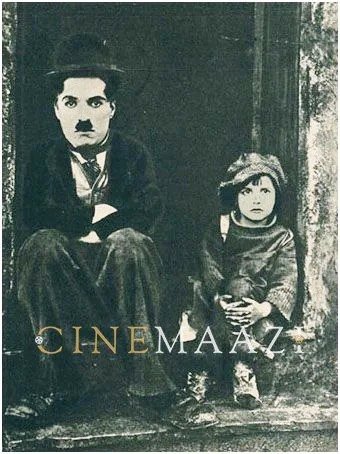
His next film, "The Kid" (1921), was a film which made five-sixths of the world weep over the fate of a neglected child. It was breathlessly awaited.
In 1923, he directed the only film in which he did not act, "A Woman of Paris,'' an advanced film technically and a much more sophisticated and adult film than any being made in America at that time.
Two years later "The Gold Rush" appeared, which last year was selected as one of the twelve best films of all time for presentation at the Brussels Film Festival.
In "The Gold Rush", Chaplin represented the Common Man struggling to find happiness in the midst of a money-minded world which hid a very real world of hunger and strife.
One sequence in this film summed up the predicament of man striving to survive: Chaplin is seen in the cabin which rocks on the edge of the abyss. He is driven by poverty to eating his shoelaces, pretending they are spaghetti; in joy, he performs a little dance with a pair of bread-rolls stuck on forks to give them legs, because the girl he loves is coming to dinner: but she never comes, for she has forgotten...
All the tenacity and pathos of man are crowded into "The Gold Rush."
With the coming of the sound film, there were people who thought that Chaplin would not be able to adapt himself to the spoken word, and that the moment Chaplin spoke in a film he would lose his magic.
Chaplin tackled the problem of the sound film with the utmost creative wisdom. His first sound film, "City Lights" (1931), was so constructed that all the characters spoke save Chaplin, until the end of the picture. Then only did Chaplin speak.
But it was not speech as expected. He has to sing a song but, forgetting the words, he makes up his own mumbo-jumbo of words.
Almost all writers on Chaplin have pointed out that, up to "City Lights," Chaplin portrayed his Little Man buffeted about by individuals bigger and more ruthless than himself.
But, with the Great Depression of 1929, which hit the American people harder and more suddenly than it hit other nations, Chaplin became conscious of the predicament of the average man in a mechanised society.
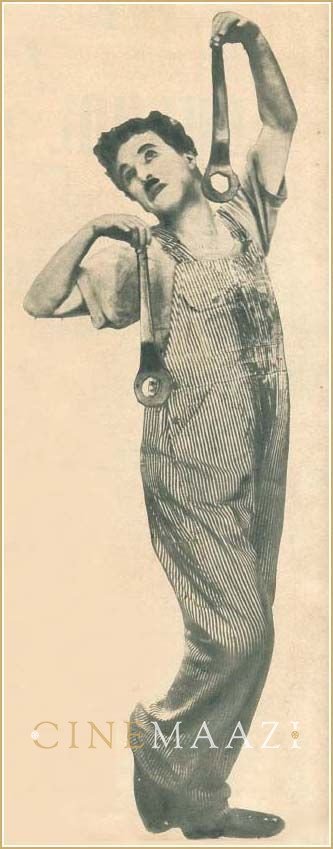
In 1936, Chaplin's film, "Modern Times,'' in which his Tramp is enmeshed by necessity into the gigantic industrial world of America, appeared. Scene after scene in "Modern Times" remains forever memorable as the rebellion of the individual against regimentation: Charlie caught at the conveyor belt with its timed movements which drive him temporarily mad! Charlie caught in the mechanisms of a giant machine; Charlie, in this speed-up world, being fed mechanically!
And Charlie innocently joining in a procession waving what seems to be a red flag !
"The Great Dictator" was released in New York, in 1940, before America joined in the Second World War. Chaplin, in terms of the highest comedy and the bitterest satire, dared to make a film of living history.
My only meeting with Charles Chaplin took place a few evenings after the release of "The Great Dictator." Unhesitatingly, he said that this film was his most important creative achievement, and he added, "It can only be truly appraised twenty years from now!"
My impressions of Chaplin have always remained as vivid as they were at the moment of the unexpected meeting: I went with a party to the New York night-club, El Morocco, as sleek and brassy a night-club as any you could find.
Suddenly, Chaplin came in with a party of several sleek and brassy people, and sat down at the next table. Someone in the party I was with introduced Chaplin and myself on the grounds that we had a mutual friend—the director, Sergei Eisenstein.
We must have talked for perhaps an hour and a half against the background of boogie-woogie jazz. Chaplin talked of everything under the sun, as if seeking an answer to the imponderable questions of society and the universe.
I became acutely aware of the contrast between this burning, passionate, questioning mind which seemed to bore into me, trying to wring out from me the answer to unanswerable questions, and the physical fragility of Chaplin.
I noticed his hand, with the very slender wrist, lying on the table, then suddenly grasping my arm to emphasise a point. I was utterly shocked that his hand and wrist were as small as my own.
I felt: If I blow too hard, he'll blow away like thistledown!
Finally, a suave waiter came with a bill. Chaplin looked at the bill lying on a plate, as if he had never seen a bill before! He rummaged in his pocket and drew out a very large wad of dollar-bills.
But, as he held them, he looked as if he had no idea what to do with them! In a most embarrassed manner, he peeled several off.
It was exactly like a scene devised by Chaplin!
The party I had come with got up. Chaplin and his party (between whom not a word had been said!) made a move to leave. We all left together.
My last view of Chaplin was as he went to get his coat from the cloak-room attendant. He looked most frightfully embarrassed as the big man helped him into his very elegant coat!
I have never wanted to meet Chaplin again, and for only one reason: He aroused a feeling of pity in me, and I found that a very embarrassing feeling to have towards one of the great creative geniuses of the Twentieth Century, one whom I had always wished to meet.
The film came seven years after "The Great Dictator." It so shocked the susceptibilities of American distributors, that it received very scanty showings in the United States.
Chaplin stepped out of his role of the Tramp and appeared as Verdoux, the bank-clerk who, after thirty years' employment, finds himself jobless as a result of the Depression. He takes stock of himself and concludes that he has the asset of "charm." Hence he goes into the business of marrying women and murdering them after he has acquired their property.
He presents himself to each of his victims in a different character, with a new set of marvellous tricks.
But, one day, it seems that Chaplin ceased to be a hurt rebel. He settled down and married a very young girl, the daughter of America's greatest playwright, Eugene O'Neill. He started all over again to raise a new family.
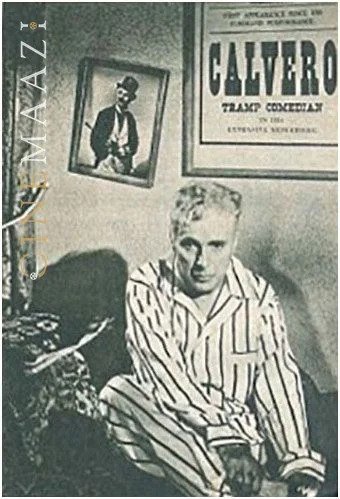
ends in the death of the clown.
When I saw it, I felt that. Charlie Chaplin had said for the public all he had to say, and that this touching film which ends in the death of the Clown should be Chaplin's creative Swan Song. He should never come before the public again.
But, alas, he did come, and "The King in New York" was a creative failure.
This article was published in 'Filmfare' magazine's 6 November 1959 edition written by Marie Seton.
The images and captions are from the original article.