









.jpg)










This section is for paid subscribers only. Our subscription is only $3700/- for one full year.
You get unlimited access to all paid section and features on the website with this subscription.
On This Day
Choose a Date
Search Cinemaazi
Select your cinema
- All
- हिंदी (Hindi)
- भोजपुरी (Bhojpuri)
- தமிழ் (Tamil)
- ગુજરાતી (Gujarati)
- অসমিয়া (Assamese)
- ਪੰਜਾਬੀ (Punjabi)
- मराठी (Marathi)
- తెలుగు (Telugu)
- বাংলা (Bengali)
- سنڌي (Sindhi)
- ಕನ್ನಡ (Kannada)
- پارسی (Parsi)
- कोंकणी (Konkani)
- മലയാളം (Malayalam)
- English (English)
- Others (Others)
- Silent (Silent)
- संस्कृत (Sanskrit)
- नेपाली (Nepali)
- ଓଡିଆ (Odia)
Subscribe to read full article
This section is for paid subscribers only. Our subscription is only $37/- for one full year.
You get unlimited access to all paid section and features on the website with this subscription.
Not ready for a full subscription?
You can access this article for $2, and have it saved to your account for one year.
- Release Date26/04/1957
- GenreDrama
- FormatB-W
- LanguageHindi
- Run Time151 min
- Length4077.31 meters
- Gauge35 mm
- Censor RatingU
- Censor Certificate NumberU-20169/57-MUM
- Certificate Date25/04/1957
- Shooting LocationMohan Studios
714 views
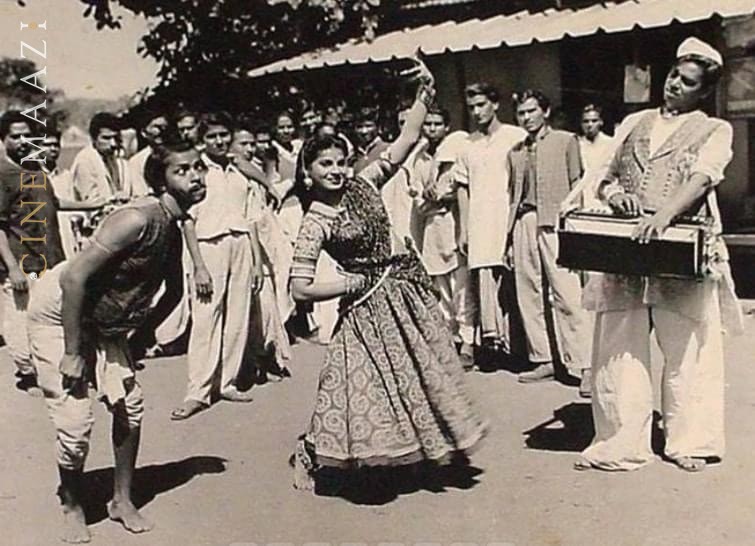
Consider a house vacant and to let: it is brick and mortar and nothing else. And again, consider the same house tenanted: it is a whole world in miniature. Here, within its walls the entire drama of human life on earth is enacted in all its shades and nuances. One might say that the boundaries of a house bring the life of the family and the individual in definite focus and sharp relief against a maze of similar patterns scattered and diffused all over the world.
"MUSAFIR" is the story of a house, and thereby the story of human life in its three essential stages-marriage, birth and death.
The house stands at the spot where two streets meet. The environment is interesting. There is the billowy music from the worn out amplifiers of two cheap restaurants flanking the house and the errand boy, who carries cups of tea and other foodstuffs to the inmates of the house from one of the restaurants. And then there is 'Munni ki Maan' the prying matron who lives in the house across the street and spies on the inmates of the house to feed her wagging tongue.
It is to this house that young Ajay and Shakuntala, having eloped together, come and live. They have eloped not only because they love each other, but also because Shakuntala was to be saved from marriage with another, and that Ajay's rich father would never have allowed Ajay to marry 5hakuntala. Despite the fear and uncertainly the couple get married. Ajay writes to his father requesting his blessings. In reply, his father arrives to denounce and disinherit him.
The tenants that come next are a sadder family: Madho Babu. a government pensioner, his widowed daughter-in-law, inconsolable for the recent loss of her husband, and Bhanu, his younger son, on whom rests the family's hope for the future. But Bhanu cannot find a lob, and Madho Babu's pension is hardly enough to run the home. One bitterness follows another until the family is threatened by certain doom.
The house never remains tenanted for long. So this family also leaves. and another follows close at its heels: a lawyer, his wide wed sister Uma, and her invalid child Raja, whose legs are smitten with paralysis, and for whose treatment the family has come to the city. The child is incurable-so the doctors think-and as if this is not enough for Uma, she meets her long lost lover, who had caused her untold misery in the past by refusing to marry her. But he is a mere shadow of his former self-bedraggled and broken, his violin his only comfort. To the already sad life of Uma, he brings more misery and heartache.
These are the three stories enacted by three different families that come to live in the house one after another. But they don't end that way, for, time as master juggler, and his bag of tricks, the Future, is inexhaustible.
[From the official press booklet]

Cast
Crew
-
BannerFilm Group Combines, Bombay
-
Director
-
Music Director
-
Lyricist
-
Producer & Financier
-
Story Writer
-
Screenplay
-
Dialogues
-
Cinematography
-
Editing
-
Sound Recording/ Audiography
-
Choreography
-
Production Controller
-
Costumes
-
Make-up
-
Laboratory/ Processed atMohan Studios Laboratory
-
Music CompanyH M V
-
StillsKamat Foto Flash
-
Publicist/P.R. O.
-
Art Direction
-
Song Recording
-
Playback SInger