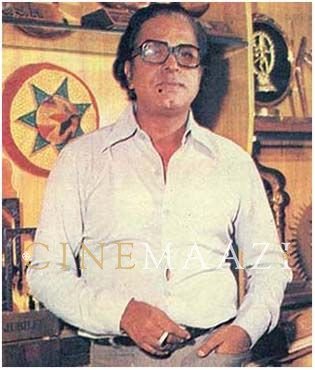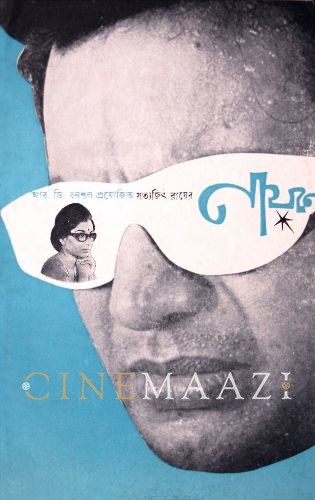
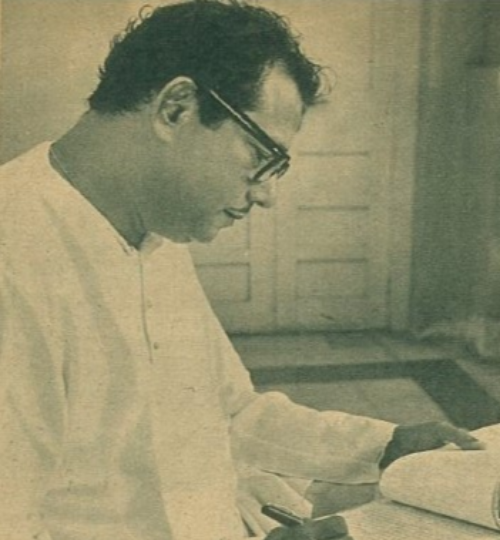


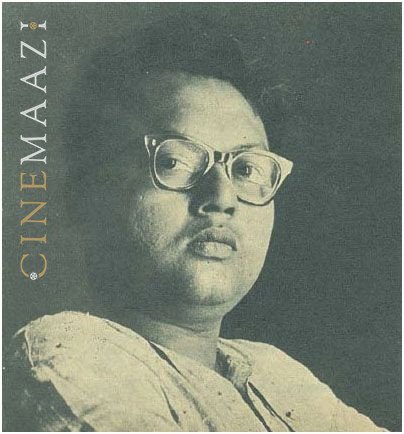
To those who are still unfamiliar with his name, Subrata Mitra can be best introduced as Satyajit Ray's cameraman. He is the man who cranked the camera for most of Ray's films. Besides the famous trilogy ("Pather Panchali," "Aparajito," "Apur Sansar"), he shot "Parash Pathar," "Jalsaghar," ''Devi," "Kanchenjunga" and Ray's latest film "Mahanagar." Currently, he is photographing "Nashtaneer" for Ray. The three Ray films that he did not photograph are "Teen Kanya," "Abhijan" and the Tagore documentary. And the only film that he has done so far outside the Ray set-up is "The Householder," recently premiered in New York where "The Times," critical of practically everything in the picture in a rather minority opinion, nevertheless found words of praise for Mitra's photography. "Teesri Kasam," which is being made in Bombay, will be Mitra's second film without Ray.
A cameraman of proven brilliance, Subrata Mitra has been lucky to be associated with a film-maker of the genius of Satyajit Ray. A good cameraman operating in a mediocre team is almost as futile as a silver thread running through a shoddy. The cameraman’s art, just one constituent of film-craft, comes alive only in a good film which is the result of most other constituents being right. If Subrata Mitra's camerawork has attracted wide notice for its vitality, it is due considerably to the fact that it has been part of vital film.
A good cameraman remains, of course, a good cameraman even in a bad film. But a cameraman associated with a good film is lucky in addition. Subrata Mitra has been, to repeat, extraordinarily lucky in being associated with Satyajit Ray-an association that has enabled his work to be viewed and admired far and wide beyond the borders of our country in a way that no other Indian· cameraman can match.
It has been reported that when "Pather Panchali" was shown at the Screen Directors’ Guild in Hollywood, many local veterans were provoked to slight the film as a work of amateurs. Literally, they were right. For, the amateurs of the film included not only many in the cast who had never faced a movie camera before, and Satyajit Ray who had never made a film before, but also Subrata Mitra who had never handled a movie camera before. It sounds incredible but the fact is that the film which won top awards at some half a dozen international film festivals and ran for a record 42 weeks in New York was the handiwork of a raw director and a raw cameraman.
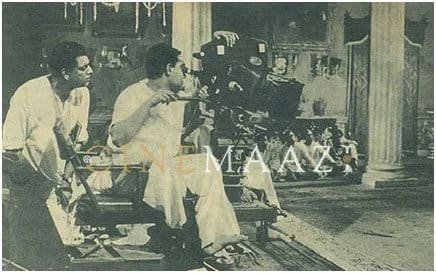
The eldest child of bis parents, Subrata Mitra was born on October 12, 1930 in Calcutta where his father worked in the India Equitable Insurance Company founded by Subrata's grandfather, Dr. S. B. Mitra, a versatile man who practised as a physician, did some research on oysters as a scientist and was probably the first Indian to obtain the M.B. degree from London.
Subrata matriculated (first class) in 1947 from the Ballygunj Government High School where Ray was much senior to him. As to his extra-curricular activities, he was in charge of the art section of a cultural club. Two years later, he passed his I.Sc. (second class) from St. Xavier's College and already began toying with the idea of becoming a cinematographer. (In the alternative be wanted to be an architect.) He had already toyed enough with a Brownie Minor camera, bad become a regular filmgoer (he could admire, at the time, only low-key photography), and had found a favourite cameraman in Guy Green of "Oliver Twist" and "Great Expectations."
Watching "The River"
Hoping to join as an apprentice, Mitra tapped a few Calcutta cameramen but without success. He then looked around for an institute for training cinematographers but there was none. Pending fulfilment of his wish to go abroad to learn cinematography, he joined B.Sc. on the advice of his parents who, unlike many of his friends, sympathised with his ambition to join films. He had spent about a year in college when Jean Renoir came down to Calcutta to make "The River." Losing no time, the ambitious Mitra met the great film-maker at the Great Eastern Hotel and obtained from him permission to attend the filming of ''River" as an observer. That was the end of his academic career.
Mitra closely watched the film's shooting, regularly made notes and detailed diagrams of lighting patterns and camera set-ups, and took stills of the production which the company used later. During "River's" filming, Mitra got acquainted with Bansi Chandragupta, the film's art director who has since worked as such on every Ray film. Another man who occasionally came to watch the "River" filming was Satyajit Ray himself who was preparing an article on Jean Renoir, later published in "Sequence." Mitra absorbed whatever know-how he could by watching "River's" filming.
Shortly after "The 'River" was completed, Mitra heard about Satyajit Ray's plan to make a film and visited him to find out if there was room for him on the project. Ray assured him that he could use him as an assistant cameraman. Ray, it seems, originally wanted the veteran cameraman Neemai Ghosh to shoot his film but when he found Ghosh too busy with his assignments in the South, he came up with a 16 mm camera and, with Mitra, began some experimental exposing with the economical idea of blowing up 16 mm to 35 mm. The experiment was dropped when the blow-up results proved unsatisfactory.
Suddenly one day, Ray, the creative artist in a hurry to create, asked Mitra if he was ready to shoot his film. Rather stunned by the proposition, Mitra faltered out something about his total lack of experience of cinematography. Impatiently, Ray asked him rhetorically—did he not already know how to handle a still camera, and then told him that there was no basic difference between operating a still camera and operating a movie camera. "Exposing for a movie," Ray told Mitra with the impatience of a budding genius, "you have only to switch the camera on."
No one aspiring to be a cinematographer could hope to get, or perhaps ever did get, more encouragement. Mitra agreed to crank the camera for "Pather Panchali." Recalling the incident, he says, "I still do not know who was more reckless—Mr. Ray in making the offer or I in accepting it." And he adds, "To my knowledge, no other film-maker in the world ever before assigned the photography of his film to a raw man. It only shows Mr. Ray's supreme confidence in himself."
When Ray next took up "Aparajito" for filming, Mitra found the opportunity to make a new experiment in lighting technique. A cameraman who observes life with his eyes open, Mitra had carefully noted that normal daylight never casts strong shadow but only faint and diffused ones on the walls and floor of an ordinary room. The quality of the normal available daylight inside a house, very different from that of direct sunlight, fascinated him and lie sought to capture it on the screen. As to a method to do so, he had studied the "bounce" light technique of the American still photographer, Irving Penn, who specialised in lighting his subjects with reflected light.
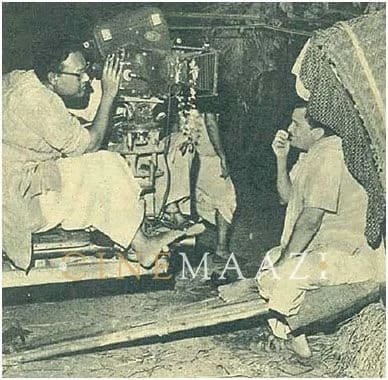
Mitra felt that the best way to achieve on the screen the illusion of available natural light would be to use the ''bounce" light technique. In this technique light is directed at the subject, whether a set or a character, not directly but indirectly by making it rebound from a reflecting surface. The bouncing technique eliminates the unreal harshness of direct artificial light, instead gives it a diffused quality which approximates more closely to the quality of the indoor daylight in everyday life.
Subrata Mitra was compelled to resort to "bounce" lighting in "Aparajito" when the set representing the interior of a house in Banaras, originally intended by Ray to be erected on an outdoor lot in Calcutta, was put up inside a studio, despite Mitra's protests, on the advice of art director Bansi Chandragupta who feared that the rains, which were approaching, would ruin the outdoor set.
Moving unenthusiastically into the studio, Mitra canopied the set with stretched sheets of white cloth, trained his lights on the sheets and shot in the diffused bounce light. The scene, which must have deceived countless others -into taking it for the real thing, deluded even a Calcutta camera technician who complimented Mitra for his location work in the Banaras house. Mitra felt very pleased with himself that day.
Since then, Mitra has used bounce lighting whenever it was called for and he thinks it is called for only when you are shooting an interior day-scene indoors. Answering why his photography is vastly different in character from the conventional work of other Indian cameramen, Mitra says, ''Your limitations impose on you a special style. Since you don't confront many limitations in a studio where practically everything is available and more or less under control, the usual results achieved there- are different." He himself solves the problem of lack of limitations in a studio by imagining and recreating the handicaps that one would meet if one were shooting in the real setting.
Against the argument, forwarded by some that bounce lighting gives "flat" images and provides no scope for modelling actors' faces, Mitra says, "Modelling depends upon the angle of light and the ratio between different lights. Whatever you can do with direct light, you can do with bounce light too. Only, bounce light is softer and sustains the illusion of available natural light. Besides having its logic, Bounce lighting is also aesthetically pleasing. In cinematography, however, there is one important point to remember—which is true of all arts— and that is restraint."
Filming In Colour
Mitra learnt with much interest from a recent issue of "American Cinematographer'' that the bounce lighting he hit upon in "Aparajito" was also employed by the Swedish cameraman Sven Nykvist (who photographed Ingmar Bergman's "The Virgin Spring" and "Through a Glass Darkly") to achieve "true, shadowless lighting" while shooting "The Communicants."
Shooting "Kanchenjunga," Ray's first colour film, Mitra repeated the history of "Pather Panchali" in handling a medium of which he had no previous experience. What's more, something went wrong with the schedule of the film's "rushes" so that Mitra saw the first "rushes" only three days before the last day of the shooting. Fortunately, the "rushes" were okay, but, Mitra reflects with a shudder, had they revealed some flaw, one could do nothing to rectify the errors. Almost the whole of the film had been shot and, as Mitra puts it, "the die was cast."
The cameraman whose camera captures reality in such a striking manner has a damaged left eye (injured in childhood by a tennis ball) and a right eye which contains a repaired retina. Shortly after "Devi," his right-eye retina got "detached," forcing him to remain in bed for many months. It took an operation to place him back behind the view-finder. He was married in 1958 and his wife, an M.A, B.T., teaches school.
What is his height, and his weight?
Replies Subrata Mitra, "Go ahead and tell the world that I am a fat, blind man and then nobody will give me any work."
This article was published in 'Filmfare' magazine's 27 December 1963 edition.
The images and captions are from the original article.
About the Author