



This section is for paid subscribers only. Our subscription is only $3700/- for one full year.
You get unlimited access to all paid section and features on the website with this subscription.
On This Day
Choose a Date
Search Cinemaazi
Select your cinema
- All
- हिंदी (Hindi)
- भोजपुरी (Bhojpuri)
- தமிழ் (Tamil)
- ગુજરાતી (Gujarati)
- অসমিয়া (Assamese)
- ਪੰਜਾਬੀ (Punjabi)
- मराठी (Marathi)
- తెలుగు (Telugu)
- বাংলা (Bengali)
- سنڌي (Sindhi)
- ಕನ್ನಡ (Kannada)
- پارسی (Parsi)
- कोंकणी (Konkani)
- മലയാളം (Malayalam)
- English (English)
- Others (Others)
- Silent (Silent)
- संस्कृत (Sanskrit)
- नेपाली (Nepali)
- ଓଡିଆ (Odia)
- Release Date26 August 1955
- GenreDrama, Social
- FormatB-W
- LanguageBengali
- Run Time125 mins
- Length3377.48 metres
- Number of Reels12
- Gauge35 mm
- Censor RatingU
- Censor Certificate Number81233
- Shooting LocationBoral, West Bengal
945 views
Nischindapur–a village on the bank of Ichamati river. Mango orchards, bamboo groves, banana and coconuts, green ponds with red and white lotuses and green hyacinths. One of a thousand such villages in Bengal....
Among its predominantly Brahmin population lives Harihar Ray (38) with his family, consisting of his wife Sarbajaya (27) , his daughter Durga (6) and a distant cousin Indirthakrun (80). Before coming to this his ancestral village, Harihar had studied the scriptures in Banaras. He has a distinct talent for poetry but has little time for it now as he is trying to settle down. This is no easy matter, for his profession of priesthood is not very paying. But Harihar is essentially an optimist, and he is helped enormously by his wife who is a shrewd and practical woman. Old Indir, who lives in a corner of the courtyard in a hut of her own, is unloved and unwanted-except by Durga. Sarba and Indir bicker constantly, and the latter usually ends up by threatening to leave home, which she does, only to be coaxed back in a few days by Durga. Durga herself goes about stealing fruits from other people's orchards, particularly those of the rich Mukherjees', their neighbours. Mrs. Mukherjee (Sejothakrun ) is a cantankerous woman who does not conceal her disdain for Harihar's family. Sarbajaya rebukes her daughter for stealing, but secretly regrets that their own orchard, their only property excepting their house, should have been confiscated by the Mukherjees. The only sympathetic friend Sarbajaya has in the village is Nilmani's wife (Na'di)...
On a cold night in the month or Magh (December-January), a son is born to Sarbajaya. Harihar is happy. Luckily enough, a few weeks later Harihar finds a job as an accountant in the zemindar's treasury. As old Indir rocks the new-born Apu to sleep, singing a lullaby, Harihar sits in the kitchen with Sarbajaya and plans for the future.
Sarbajaya is infected by her husband's optimism and dreams of better days...
SIX YEARS LATER
Harihar is still drudging in the zamindar's treasury... the house looks more dilapidated... Indir and Sarbajaya still bicker and quarrel. Durga, now twelve, has developed into an expert fruit-stealer. The boy Apu, pampered both by sister and mother, has just started going to the local school. The school has eight other students and is run by a Pandit who also keeps a grocery store, and who relies more on the cane than on any text-books to impart knowledge. Apu, however, is a good pupil and generally manages to escape chastisement.
Sarbajaya is growing tired of her husband's complacence and constantly reminds him of his promises and his ambition. "At least try to assert yourself at the zamindars and insist that they pay you regularly if not handsomely. This way we will soon begin to starve... "
One afternoon while Sarbajaya is feeding Apu, there is a sudden invasion by Mrs. Mukherjee and her two daughters. Mrs. Mukherjee demands to see Durga. Sarbajaya, taken aback, asks what has happened. Mrs. Mukherjee "accuses Durga of having stolen her daughter Panchi's necklace that afternoon. Durga arrives, is searched; but the necklace is not found on her person. Mrs. Mukherjee, frustrated, lets loose her tongue and bitterly accuses Sarbajaya and her pettiness, corruption and downright thievery. Then she leaves as dramatically as she came. Sarbajaya, hurt and humiliated beyond words, vents her rage on Durga and literally throws her out of the house. Indir intervenes, only to be rebuked. Apu watches horrified.
After a while Sarbajaya realises the extent of her cruelty, asks Apu to go and find Durga and fetch her back, which duty the boy performs only too gladly...
That night (it is the month of September) while Indir tells a fairy tale to the two children, Harihar returns home with three months' pay (which had been due) and good news: the offer of an Initiation ceremony in a rich peasant family. Harihar, however, is in no hurry to accept it, for he has a sense of dignity.
While Harihar drowses, Sarbajaya although vexed by her husband's delay in seizing this opportunity is still prepared to look forward to the future with confidence. She mutters to herself ; "I wish we could leave this wretched place and go to Banaras. It is so much better in the city. No one respects you here. There is nothing but poverty and humiliation..."
Just before the Pujas, Sarbajaya has her bitterest quarrel with Indir. This time the old woman leaves fully determined never to return ....
The Puja comes. Apu and Durga, who do not feel the sting of poverty as much as the elders do, enjoy it in their own humble way. Apu's imagination is fired by a Jatra (a village theatre) performance and at home he dresses himself up as a king, having helped himself to knick-knacks and ornaments from his sister's box. Durga discovers the theft and the two have a fight. Durga pretends to be piqued and runs away, out of the village, along the river, across the meadows and the paddy fields. Apu follows desperately afraid that he will lose his sister's friendship. On the edge of an unknown Kash field, the two are reconciled and their long journey is rewarded by their first, totally unexpected and wondrous glimpse of a railway train ....
But old Indir returns again! This time she is ill and begs that she be allowed to die in her home. But Sarbajaya, incredulous, sternly refuse . So Indir has to leave again tottering.
Apu and Durga, returning from their sight of the train, catch sight of Indir lying beside a bamboo grove. They move close to her, gladdened by the discovery of their beloved aunt. But Durga, wiser and older of the two, realises with a shock that Indir is dead...
Agrahayan (November-December): As planned, Harihar sets out for the Initiation ceremony at the rich peasant's house. "I shall be back in a week's time", he says, "and with the money I will have earned, I shall get the house repaired. It is doubtful if it will last through another monsoon without repair..."
Sarbajaya prepare for their coming prosperity.
But what is this? A postcard from Harihar!
And it is disastrous news. The rich peasant has suffered two deaths in the family through malaria. No question of Initiation now! Harihar is proceeding to the city where by reading from scriptures, etc., he will earn enough for the repairs, and thereupon return.
Sarbajaya, shaken at first, realises that weakening will make matters worse and decides to face whatever is in store for them.
Days run into weeks, and weeks into months. Winter comes and goes, but there is no letter from Harihar. The Mukherjee's eldest daughter, the charming and gentle Ranu (a favourite of Durga) gets married. The wedding touches Durga, who realises for the first time that she will also one day get married and have children. She begins to take more care of herself and perform the Bratas she had so far neglected. Apu finds his thirst for knowledge growing and along with it grows his sense of wonder and curiosity.
But their poverty grows too. Sarbajaya finds herself fighting a losing battle and begins secretly to sell and pawn her possessions. But Nilmani's wife finds out and generously offers help. Sarbajaya, reluctant at first, is later forced to accept.
25th of Chaitra (April): Like a ray of light in the ever-increasing gloom comes Harihar's postcard. Good news! He has collected the money and will be returning home in a week or so. Sarbajaya sheds tears of joy.
1st of Baishakh (April)*: As Durga performs the Punyipukur Brata, a ritual for young girls, suddenly, without warning comes the season's first Nor'wester. Durga leaves her Brata, runs out and meets Apu in the mango orchards. Then comes the rain. Durga, deliriously happy, makes for the open spaces and gets thoroughly drenched while Apu, less adventurous, takes shelter under a tree.
Durga catches a cold which develops into pneumonia. The village doctor does his best-which is really not much.
On the dark, stormy night, Durga dies in her mother's arms...
For six days and six nights, Sarbajay remains like one petrified, while Apu wanders about, bewildered and lonely.
On the tenth of Baishakh, Harihar returns. The disaster that meets him stirs him to the depths of his heart. It also makes a new man of him.
His daughter dead, his house in ruins, Harihar decides to leave Nischindapur to seek a living in Banaras. This is not what he had looked forward to, but he accepts his fate and takes a realistic decision in spite of being discouraged by his neighbours.
Two important incidents occur on the day before their departure. Sejothakrun has a change of heart and brings Sarbajaya a basketful of mangoes for their journey. And Apu discovers something in a corner of a dust-laden shelf of their house-the necklace belonging to Panchi. This he promptly throws into the nearby pond.
On the 25th of Baishakh, at dawn, Harihar leaves his ancestral home with his wife and son.
As the rickety bullock cart lumbers down the village road, the rising sun is seen to break through the clouds for the first time after a long stretch of gloomy days.
*Bengali New Year's day.

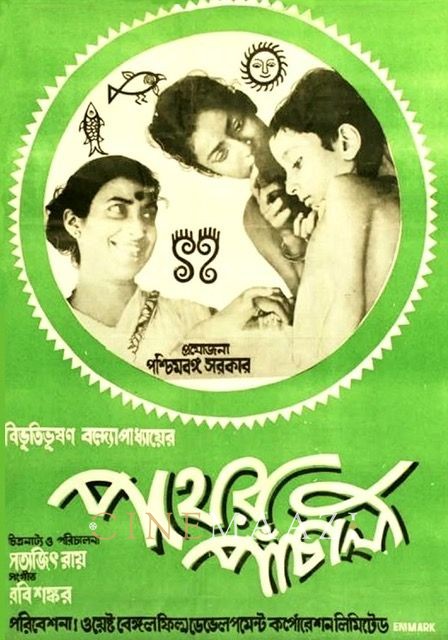
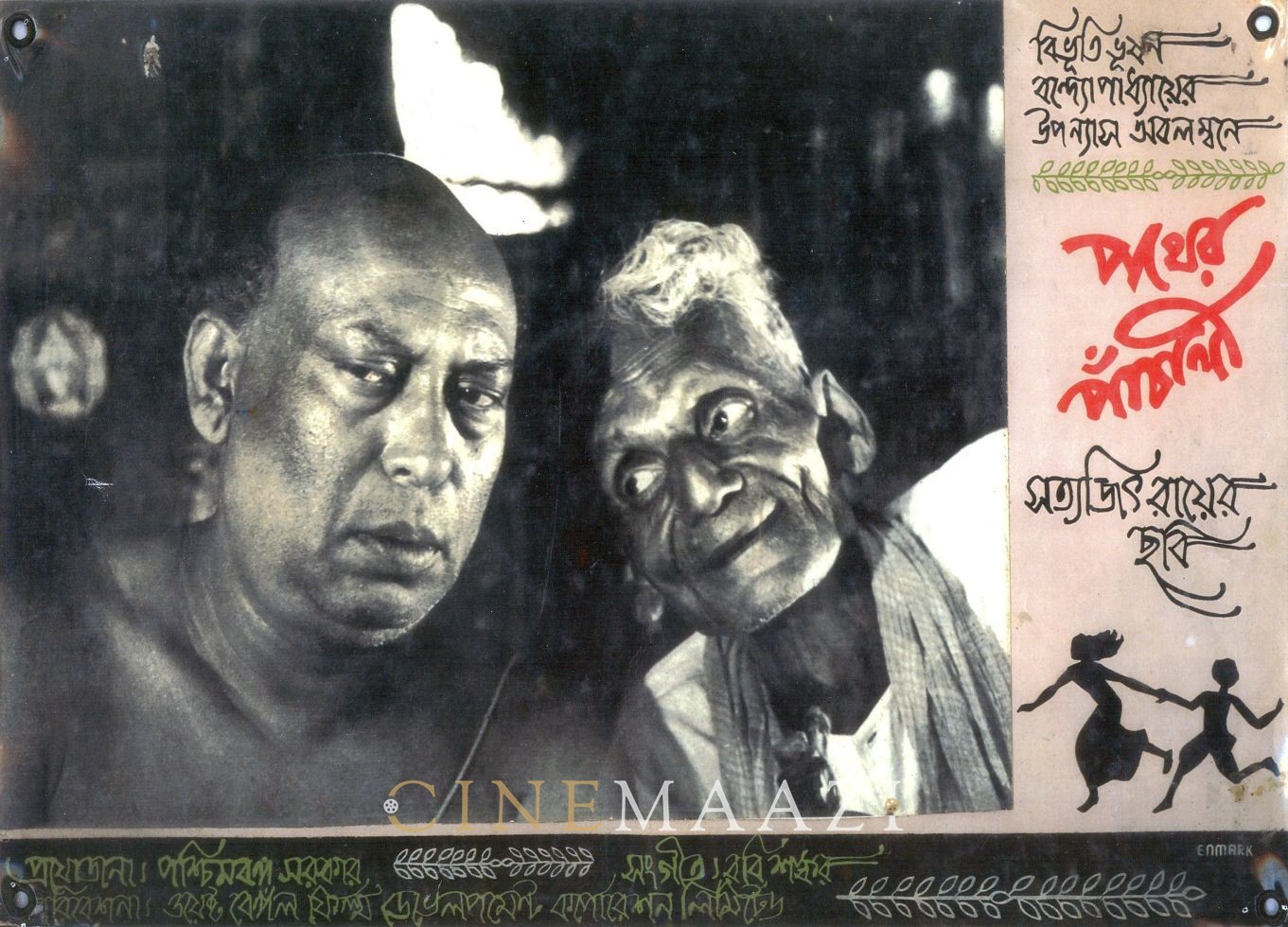
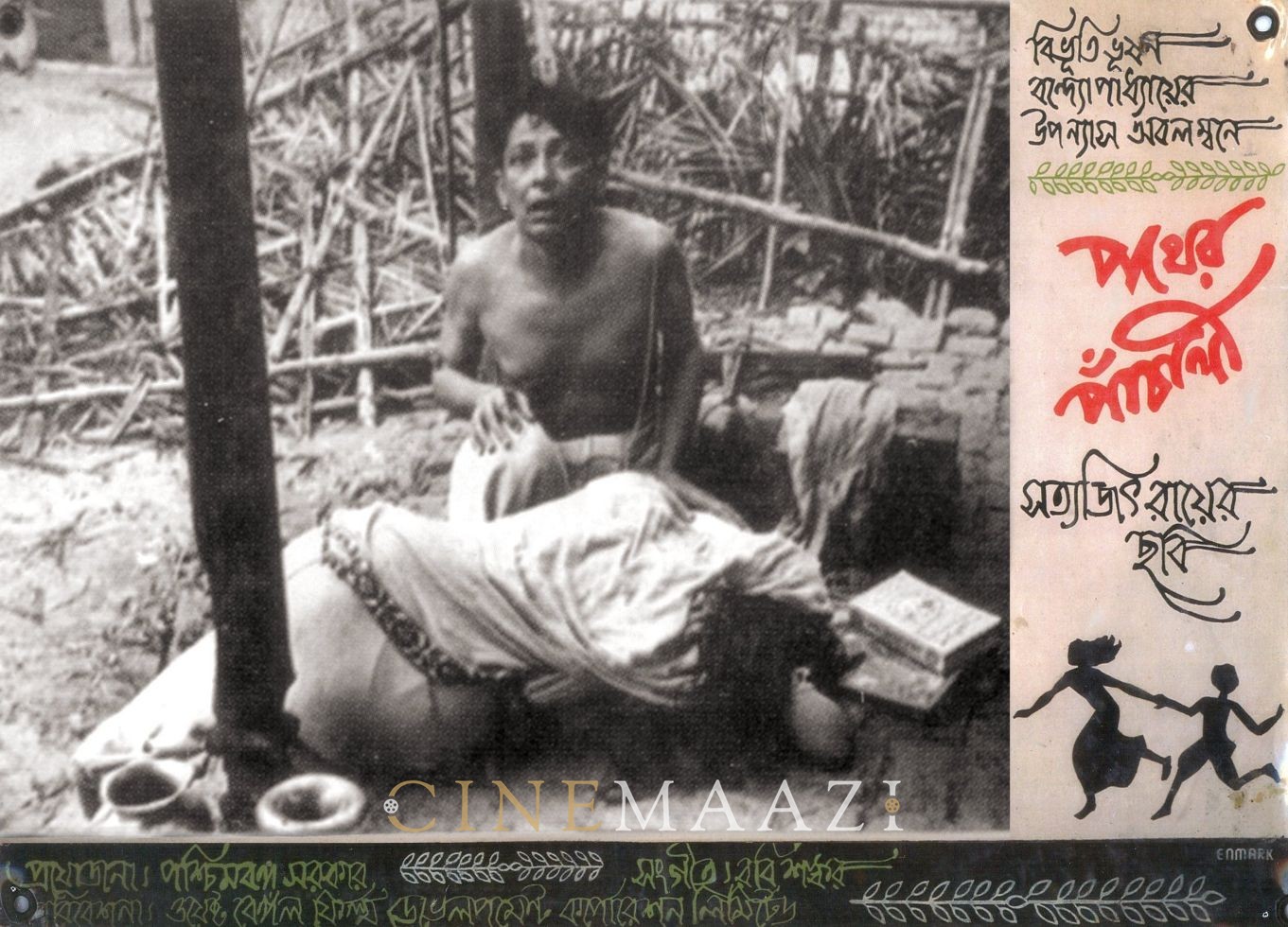
Cast
-

Kanu Banerjee
Harihar -
Karuna Bannerjee
Sarbajaya -
Uma Das Gupta
Durga -
Runki Banerjee
Little Durga -
Subir Banerjee
Apu -
Chunibala Devi
Indirthakrun -
Reva Devi
Sejothakrun -
Nivanani Devi
Dasithakrun -
Aparna Devi
Wife of Nilmani -
Tulsi Chakraborty
Village Teacher -
Binoy Mukherjee
Vaidyanath -
Haren Banerjee
Chinibas Confectioner -
Rama Ganguli
Ranu -
Harimohan Nag
Chakkotti
Crew
-
Director
-
Music Director
-
Story Writer
-
Cinematography
-
Editing
-
Sound Recording/ Audiography
-
Art Director/Production Design
-
Laboratory/ Processed atBengal Film Laboratories
-
Production Manager