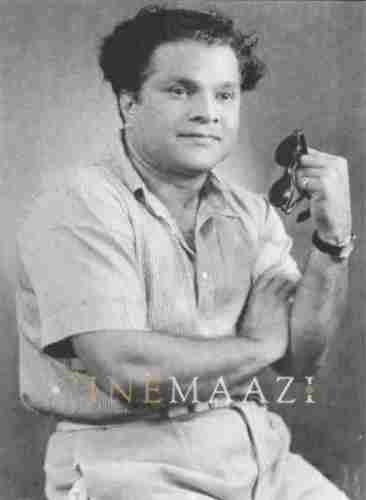
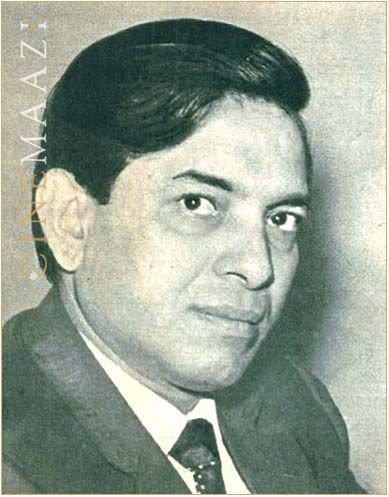
Ravi - The chorus-boy of yesterday is today's conjurer of enchanting melodies echoed by a million lips
Subscribe to read full article
This section is for paid subscribers only. Our subscription is only $37/- for one full year.
You get unlimited access to all paid section and features on the website with this subscription.
Not ready for a full subscription?
You can access this article for $2, and have it saved to your account for one year.
The spacious Vallabhbhai Patel Stadium in Bombay was overflowing with people. On stage was a variety entertainment programme called "Baisakhi-Di-Raat." Quite a glamorous bunch of film celebrities were participating in it. As the programme was nearing the end, many people, eager to be early in the bus queues or luckier in the scramble for the taxis, started working their way to the exit.
Just then, the deep voice of singer Mohammed Rafi began booming through the loudspeakers filling the whole area with the soulful notes of a heady melody. It was a song from an unreleased picture. Rafi throated only the first line of the song when a sensation seemed to grip the spectators. Those who had got up to go hurriedly retraced their steps or came to an abrupt halt looking somewhat like game caught in the glare of the hunter's flashlight Even the chauffeurs left their cars and rushed to besiege the stadium gate.
To many this was the first introduction to the song-a sensational introduction to a sensational song.
The song was "Chaudhvin Ka Chand Ho" from Producer Guru Dutt's film "Chaudhvin Ka Chand." The young composer of the song, music director Ravi, who was away from the scene, felt happy and grateful when he heard how thrillingly his song had been received by the "Baisakhi-Di-Raat" audience. And he is quietly happy today when the song has become one of the top-selling records in the country.
The song, which for the last so many months has almost been inescapable, for the ears throughout the length and breadth of the country, was lying for quite some time as just another tune attached to some makeshift words in the musical storehouse which composer Ravi's memory is.
Quite a few friends of Ravi had heard the tune, but it was only when Ravi and lyricist Shakeel Badayuni, working together in "Chaudhvin Ka Chand," married the tune with carefully chosen words and presented the final composition to Guru Dutt, that the song took its first step towards its destined glory. Guru Dutt and others who heard the song liked it without reservation, though Ravi remembers someone saying that the song was too "slow" to be popular.
Is the sensational success of this song just a happy accident that has happened to a lucky young music director? Well, a glance at the musical career of Ravi proves that if the success of the title song in "Chaudvin Ka Chand" is an accident, such accidents have happened to him frequently before.
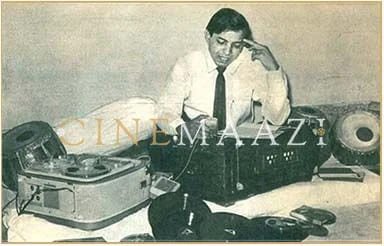
Ravi came into the limelight only a few years ago and already he claims a list of over three dozen bit songs. Among the more memorable of his songs are ''Chanda Mama Dur Ki" and "Babu Ik Paisa Dedo" (from "Vachan"); "Apne Kiye Par Koi Pasheman Ho Gaya" ("Mehndi"); "Cat Mane Billi," "Hum To Mohabbat Karega," and "Oh Babu, Oh Lala" ("Dilli Ka Thug"); "Sub Kuchh Luta Ke Hosh Men Aye To Kya Kiya," "Ulajh Gaye Do Naina" and "Chhum Chhum Chali Piya Ki Gali" ("Ek Saal"); "Yeh Jhoomte Nazare" and "Tose Lage Naina" ("Nai Raahen"); "Mere Geeton Se Hai Tujhko Pyar, Gori Tujhe Ana Padega" ("Albeli"); and "Tim Tim Karte Tare" ("Chirag Kahan Roshni Kahan").
Today he is one of the most sought-after music directors in film land. He has assignments simultaneously in some fifteen pictures which are expected to be completed within two years. Theoretically this means that, roughly, he must compose, orchestrate, rehearse and record at least one new song every week.
How can he cope with such heavy demands on his tunesmithship? Ravi believes he could easily cope with heavier demands. He says that fashioning a new tune is no difficult job at all. And to illustrate his point he takes the refrain of any song and straightaway sings it in half-a-dozen different ways pausing only to draw breath. And in each new musical clothing the refrain sounds like the title line of a new hit song.
And whenever there was a function at the school he would go up to the stage and sing "Govardhan Girdhari". In time the song became such a stock item of Ravi's repertoire at school functions that many of his friends and teachers started greeting him with "Hello, Govardhan Girdhari!"
In those days Ravi only sang, knew not how to play a musical instrument. And whenever he sang in public, someone else would accompany him on the harmonium. But the harmonium players often would not bother to adjust the octave to suit his vocal range with the result that, while singing a song which he always sang well at home, he would suddenly find himself off key and shrieking rather than singing, That provoked him to learn to play the harmonium which he did from a friend of his father's.
Having lost interest in studies (he somehow scraped through his matriculation), Ravi joined an electrical firm, and then for five years served as an electrical "hand" in the Post and Telegraph Department's Trunk Exchange.
During this time someone came along with a wire-recorder at a local exhibition in Delhi. The man with the wire-recorder invited people to sing or speak into the gadget and hear their voices back. Full of curiosity, Ravi turned his face to the recorder-mike and sang "Tere Kuche Men Armanon Ki Duniya Le Ke Aya Hoon."
When he heard his voice reproduced he was thrilled. And he was convinced that he had a good singing voice. The next thing he did was to take three weeks' leave and visit Bombay with the aim of becoming a playback singer in films.
Ravi entered films as a chorus singer and he recalls with a smile how thrilled he used to feel when he would be among the chosen six or seven picked by an assistant music director from a large crowd waiting at some studio. The selection meant twenty to twenty five rupees and scores of people used to scramble madly for the opportunity.
From a chorus singer Ravi became assistant to music director Jimmy in Filmistan. Soon afterwards music-director Hemant Kumar picked him up as his assistant. Producer-director Devendra Goel was the first to give a break to Ravi who composed his first songs in Goel's "Vachan." A number of songs in the picture became "hits" and since then Ravi's career has been a more or less uninterrupted success story.
Has success spoiled Ravi? Those who know him well do not think so. And he himself does not give the impression of a man saturated with the sense of self importance.
Is he a difficult music director in the sense that he does not easily accept suggestions and revise a tune he has submitted to a producer? Far from it, he attaches all respect to the opinion of a producer. The song "Badle Badle Mere Sarkar Nazar Aate Hain," he composed in as many as five variations. One of those tunes was affectingly sad but, as he puts it, "It brought to mind the picture of a classical singer singing at a musical conference." And so the tune was discarded in favour of the one which the song now has.
Ravi generally takes an orchestra with no more than 35 pieces. And he has also composed a song which needed only a two-piece orchestra, the two pieces being a "tanpura" and a "tabla." Which instruments does he like more than the others? He says that flute, "sitar," and "shehnai" have an especial appeal for him. What has he to say about westernised compositions? He sees nothing wrong in them if the situation in a picture demands them.
What are Ravi's ambitions?
In reply, the man who speaks the "speech of angels," as music has been called, only smiles shyly and says: "Just pray to God that I may go on earning my daily bread."
This article was published in 'Filmfare' magazine's 16 December 1960 edition.
The images and captions are from the original article.
Tags

.jpg)

social media

Released in 1986, Jaanbaaz remains one of the most stylish and ambitious films of 1980s Hindi cinema. Produced and directed by Feroz Khan, the film blended family drama, romance, action, and crime within a visually lavis...
View on Facebook
Mumtaz Shanti remains one of the most luminous stars of 1940s Indian cinema and is often remembered as Hindi cinema’s first true female superstar. Celebrating her birth centenary is an occasion to revisit the extraordina...
View on Facebook
See posts, photos and more on Facebook.
View on Facebook