
“You can pick up a man from the gutter and make him a star overnight. But you cannot get a cinematographer that way. The cinematographer is necessarily a skilled technician with years of training behind him.”
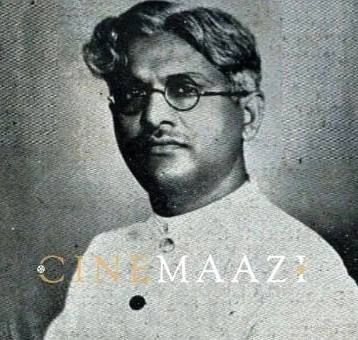
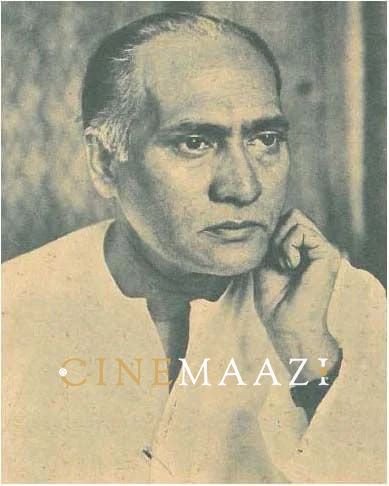
The man who says this is Dilip Gupta, one of India's best and seniormost cinematographers now active behind the cameras. When he cranked the camera, over two decades ago, for his first independent assignment in New Theatres' "Street Singer," Dilip Gupta had already acquired years of practical experience and theoretical knowledge of cinematography, both at home and abroad. At home, he had been an assistant cameraman for years and had acted as operative cameraman on such notable films as "Dhoop Chhaon" and "President." Abroad, he had studied cinematography for two years in New York where he also pocketed a diploma in his craft. To date, he has been in films for around 33 years and during the period he has exposed away millions of feet of film. "Bhai Jan," which he is currently lensing for Producer Bimal Roy, is the 36th film to be photographed by him.
Good Photography
“A cinematographer," says Dilip Gupta, "must be an artist. He must have—most important of all—a sense of composition and lighting". But the sense of composition, adds Gupta, should not degenerate into a penchant for arty work. Good photography is not stilted, artificial frames; it is subtly efficient so that no spectator notices its existence while seeing the film. If he does, says Gupta, the photography has failed, for the aim and function of photography is to secure the audience’s absorption in the story being told on the screen, and not to call attention to itself.
Dilip Gupta's photography in Bimal Roy's "Madhumati" did not call attention to itself and yet it received everybody's respectful attention when it won for him ''Filmfare's" Best Photographer Award for 1958. "Madhumati" is not the only example of Dilip Gupta's distinguished photography. There are numerous others, too, like Nitin Bose's "Deedar," Bimal Roy's "Biraj Bahu," Filmalaya's "Dil Deke Dekho," Nasir Hussain's "Jab Pyar Kisise Hota Hai." And he also photographed that unusual and arresting documentary, "Gautama, the Buddha."
Dilip Gupta, who has so far handled only black-and-white photography but is ready and willing to do his first colour film, says that black-and-white photography is more challenging than colour photography. But he admits that, while black-and-white photography allows some latitude for error, colour photography requires exactitude in exposure.
Dilip Gupta was born in Calcutta in 1911. His father, a businessman, died when he was only six, and so the responsibility of his up-bringing was taken over by his grandfather. Not too interested in studies, he cut off his school career this side of matriculation, and about the age of eighteen he managed to meet B. N. Sircar to tell him about his interest in films. Sircar gave him an important role to play in "Chor Kanta," a silent Bengali film that was photographed by Nitin Bose.
While working in the film, Dilip Gupta found himself fascinated by Nitin Bose's craft and began paying a lot of attention to it. By the time "Chor Kanta" ended, Dilip Gupta was eager to join Nitin Bose as his assistant. But B. N. Sircar had already thought of another role for him in the next film. So Nitin Bose asked him to make up his mind whether he wanted a career before the camera or behind it.
"Behind the camera," was Dilip Gupta's answer and it led to his assisting Nitin Bose on a number of films. After a couple of years of apprenticeship, he persuaded his grand-father to send him to the United States to learn cinematography. And so he sailed for America early in 1932. Most of his time abroad he spent in New York learning photography, although later he visited Hollywood also where he was for some time attached to the Paramount Studios.
Returning to India in October 1934, he joined the New Theatres as an operative cameraman. After "Street Singer," he worked again as cameraman with Director Phani Majumdar on "Kapal Kundla." Then he did a couple of films outside New Theatres for P. C. Barua, including "Shapmukti."
Direction and Camera
He migrated to Bombay in August 1942, just when the Quit India movement had flared up. He recalls how, on his arrival in Bombay, he was held up at the Victoria Terminus station due to the city being under the blanket of curfew. His first film in Bombay was "lnkar," for Producer Chimanlal Trivedi. The second was "Sharafat", with which he made a name for himself. Among the films he photographed in later years are "Dil Ki Baat," "Parinde," "Pehli Nazar" and "Parwana." Among his most recent ones are Bimal Roy's ''Usne Kaha Tha" and "Prem Patra."
Dilip Gupta emphasises the necessity of an imaginative director with a good camera sense for a cinematographer to be able to do inspired work. He says he finds such inspiration while working with Bimal Roy, himself an ex-cameraman of repute. Dilip Gupta is also all praise for the camera sense of Satyajit Ray.
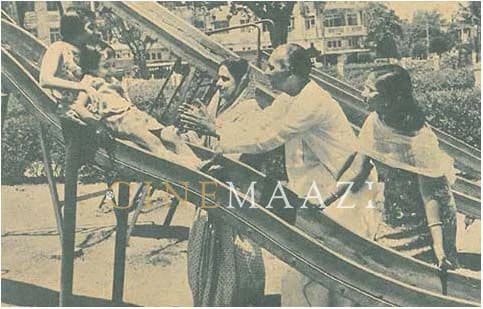
Married in 1936, Dilip Gupta, the father of five daughters—two of them married—leads a quiet life with his family when he is not quietly cranking the camera in a studio.
This article was published in 'Filmfare' magazine's 3 May 1963 edition.
The images and captions are from the original article.
About the Author